THE LEXICON / Fashion vs. fashion
Viktor & Rolf AW 1999Russian Doll
One model stood on a turning platform while the designers put nine outfits on her, one over another, like a Russian doll. It turned dressing itself into the show.
Provenance
This entry refers to Viktor & Rolf's Autumn/Winter 1999 Haute Couture show, officially titled the "Russian Doll" collection. Instead of a traditional runway procession, the 15-minute presentation featured a single model, Maggie Rizer, standing on a rotating turntable pedestal like a "toy ballerina in a music box." Throughout the show, the two designers, dressed entirely in black, acted as petites mains and painstakingly dressed Rizer in real-time in front of the audience. The presentation was a massive critical success, with Vogue editor André Leon Talley famously dubbing it "the Viagra of couture week."
Critique
Institutional Critique & The Speed of Fashion: The "Russian Doll" collection functioned as a profound commentary on the relentless cycle of consumption and the breakneck speed of the fashion industry. The staggering accumulation of clothes visually represented the "sedimentation of fashion" and the burden of constant overproduction. Parody vs. Homage: The performance walked a fine line between satire and reverence. While the absurd, immobilizing weight of the final layered silhouette parodied the ludicrous inaccessibility of haute couture, the meticulous, real-time dressing process paid genuine homage to couture as a highly crafted "laboratory of ideas." Subverting the Catwalk: By stripping away the traditional linear catwalk procession and forcing the audience to watch the intimate, backstage act of dressing, Viktor & Rolf transformed the models from passive hangers into participants of performance art. Materiality Over Immateriality: While heavily conceptual, critics note that the collection was an exercise in haptic visuality. By highlighting the heavy weight of the clothes, the visible warmth experienced by the model, and the tactile differences between raw jute and fine lace, the designers anchored their abstract intellectual concepts firmly within the tangible, physical reality of the garments and the human body.
Strategy
Sequential Layering (The Matryoshka Effect): The primary structural logic mirrored a Russian Matryoshka doll. Rizer began the show wearing only a frayed, raw minidress made of hessian sackcloth/jute. The designers systematically added nine to ten layers of couture garments on top of one another. Interconnected Componentry: The layering was not random; each successive garment was engineered to fit over the previous ones, acting as "pieces in a puzzle" where each new layer completed or mirrored a detail from the preceding tier. Material Tension: Viktor & Rolf deliberately contrasted unfinished, unconventional fabrics (like the frayed jute) with highly traditional, opulent couture materials, incorporating silk satin, heavy brocade, delicate lace, and intricate crystal and diamante embroidery. Monolithic Massing: As the layers accumulated, the model's physicality was engulfed by the sheer mass of the garments (weighing in excess of 70 kilograms). The final silhouette was a towering, bulbous cocoon-coat featuring shoulder pads raised high above her head and a colossal rose embellishment, making her head appear "shrunk to the size of a walnut."
Looks
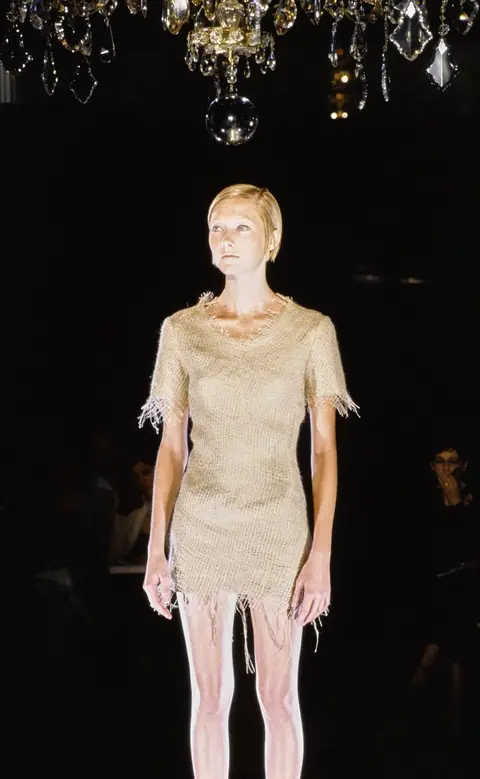
- Frayed Hessian Minidress
- The frayed hessian minidress provides the foundational layer of the entire performance. It covers the torso in a raw scratchy jute textile. This material selection engages with institutional critique by presenting the cheapest agricultural sackcloth as the literal baseline of haute couture. The edges are violently frayed at the neckline and hem to emphasize the unrefined nature of the textile. This garment asserts a brutal material honesty before the subsequent accumulation of luxury layers.
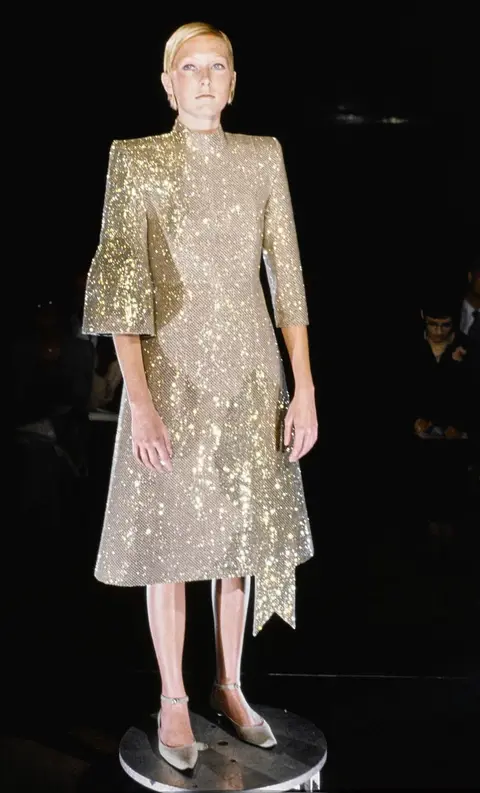
- Crystal-Embellished A-Line Dress
- The crystal-embellished A-line dress envelopes the body in a dense matrix of reflective diamante and metallic sequins. It completely obscures the rough hessian underlayer. This material application utilizes haptic visuality to sharply contrast the scratchy jute with cold hard luxury embellishments. The heavy fabric falls rigidly from the high shoulders to the knee. The garment refuses soft fluidity to assert an armor of overwhelming opulent weight.
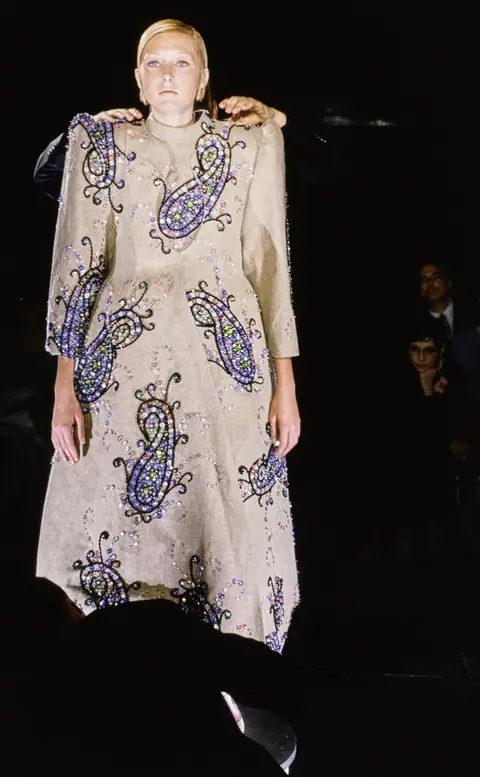
- Couture Embellished Sackcloth Coat
- The couture embellished sackcloth coat fuses the raw jute of the foundational layer with intricate beadwork and heavy embroidery. It introduces intense material tension to the silhouette. This hybrid construction applies postmodernism by collapsing the binary between "low" agricultural textiles and "high" Parisian craft. The stiff fabric is tailored with structured shoulders and a flared skirt. The piece asserts that the process of couture can elevate even the most banal materials into objects of intense luxury.
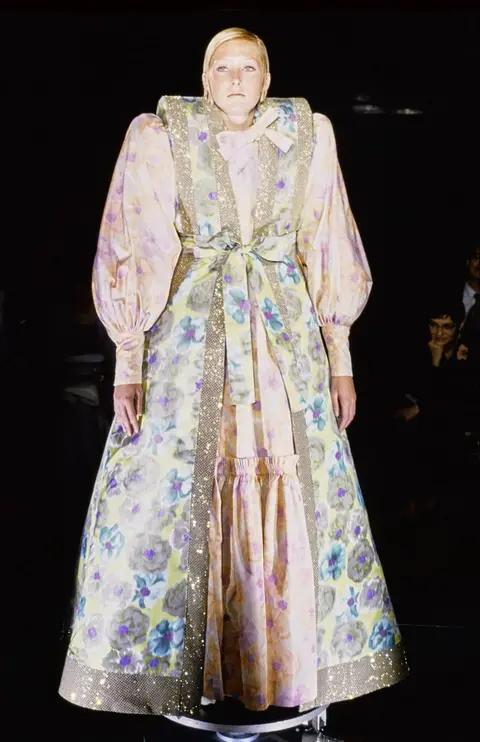
- Sequined Floral Brocade Overcoat
- The sequined floral brocade overcoat adds another massive layer of volume over the preceding garments. It features a bright yellow and purple pastel pattern heavily encrusted with reflective media. This structural logic utilizes sequential layering to physically expand the model's footprint on the pedestal. The oversized sleeves are pushed up to reveal the cuffs of the layers beneath. The front hangs open to expose the complex puzzle of the accumulated clothing. The outerwear asserts the visual fatigue of relentless overproduction.
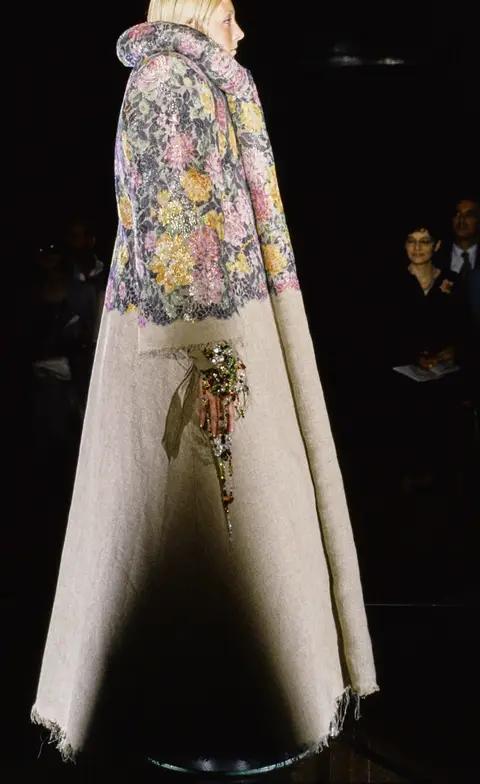
- Heavy Lace Applique Overcoat
- The heavy lace applique overcoat wraps the accumulating silhouette in a dense floral textile. It is heavily embellished with dark metallic beading along the hemline. This material addition engages with the sedimentation of fashion by literally piling historical decorative techniques on top of one another. The wide sleeves bunch heavily around the wrists. The thick collar stands rigid against the neck. The garment refuses lightweight mobility to complete the physical encasement of the wearer.
- Intricate Beaded Glove Accessory
- The intricate beaded glove accessory extends the heavy embellishment directly onto the model's hand. It features a dense cluster of multi-colored crystals and jewels. This styling choice invokes the sheer excess of haute couture detailing. The heavy gems drip from the fingers like a physical manifestation of wealth. The accessory completes the look by ensuring no part of the anatomy remains untouched by the opulent accumulation.
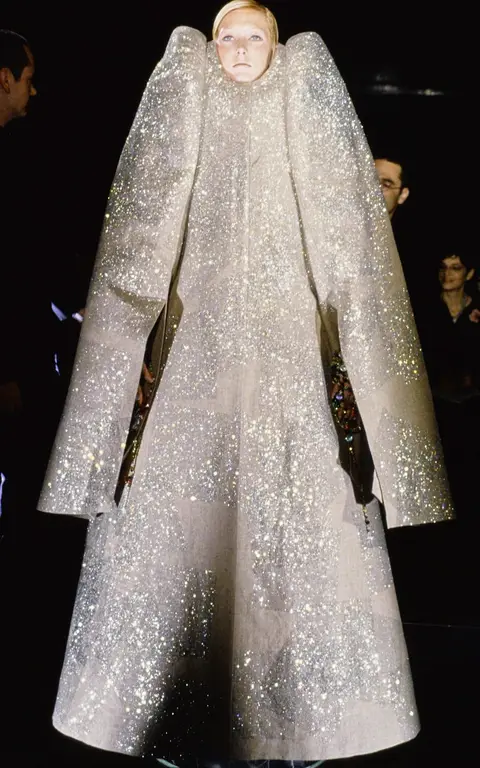
- Towering Crystal-Encrusted Carapace
- The towering crystal-encrusted carapace raises the shoulder line drastically above the model's head. It consumes her entire upper body in a massive reflective pyramid. This structural extreme applies monolithic massing to parody the ludicrous inaccessibility of haute couture. The stiff fabric is covered entirely in silver sequins and diamante. It leaves only a small opening for the face. The garment asserts a final suffocating layer that transforms the human form into a static glittering monument.
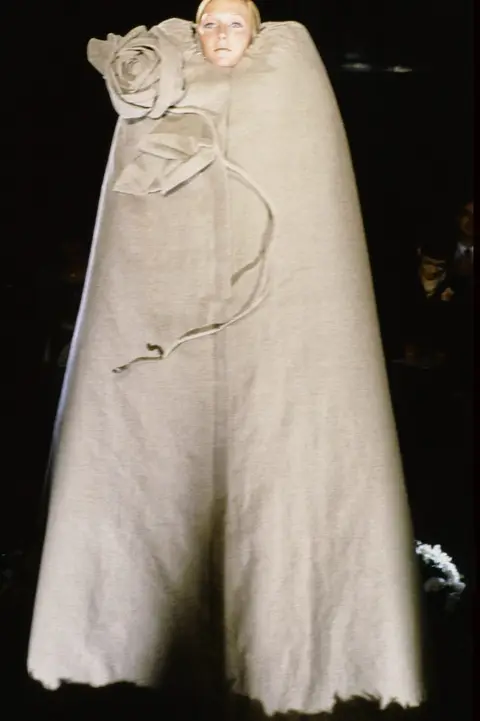
- Colossal Rosette Cocoon-Coat
- The colossal rosette cocoon-coat represents the final heaviest layer of the performance. It completely engulfs the model in a massive beige structure topped with a giant fabric rose. This displaced anatomy utilizes internal scaffolding to create a silhouette that shrinks the model's head to the size of a walnut. The immense weight of the accumulated 70 kilograms of clothing is visibly anchored within this final shell. The coat completes the presentation by turning the wearer into a fully immobilized object of performance art.
Photographs: Condé Nast Archive, via Vogue Runway. Reproduced for criticism and review under CDPA 1988 s.30.
Quick facts
- Era
- 1990 to 1999; The Deconstructionist Decade
- Politics
- Anti-Consumerism & Institutional Critique, Labour Politics & Industrial Production
- Theories
- Conceptual Fashion, Aesthetic Philosophy, Postmodernism
- Form & anatomy
- Monolithic Massing, Scaffolding and Internal Frameworks (Sequential Layering)
- Materials
- Heavy/Untreated Fabrics (Jute / Hessian Sackcloth), Luxurious Textiles (Silk Satin, Brocade, Lace), Reflective & Refractive Media (Crystals, Diamante, Metallic Sequins)
- Geography
- Paris (Chambre Syndicale / Haute Couture)
- Gender
- Womenswear
- Format & medium
- Theatrical Stage Performance
Sources
- Viktor & Rolf ensemble (Russian Doll), The Metropolitan Museum of Art — MetCollects.
- “Eighth Preparation Dress from Russian Doll Haute Couture Collection, Autumn/Winter 1999–2000”, MIT Libraries (Dome).
- Viktor & Rolf: Fashion Artists — artwork labels, National Gallery of Victoria, 2016.
- “How Viktor & Rolf Interrogated Consumption Through Couture”, AnOther Magazine.