THE LEXICON / Technology and the future
Balenciaga SS 2007Robotic Articulation
Nicolas Ghesquière sent out models in shiny gold leggings and metal legs that looked like robot parts. It mixed fashion with sci-fi and asked where the human body ends and the machine begins.
Provenance
Nicolas Ghesquière presented his Spring and Summer 2007 ready-to-wear collection for Balenciaga in October 2006 during Paris Fashion Week, staging a presentation widely regarded as a pivotal moment within both the house's trajectory and broader fashion history. Ghesquière had helmed Balenciaga since 1997, and this collection represents the apex of his methodology — a forensic translation of Cristóbal Balenciaga's historical architectural volumes into a language of post-industrial sportswear and techno-functional precision. The collection introduced two canonical archetypes: the Town leather jacket (a fluid modernization of the biker silhouette) and the City handbag (an architectural accessory defined by chain-link metalwork), alongside the triple-strap sandal whose cage-like structure was directly derived from the mechanical binding hardware of snowboarding boots. The Balenciaga Spring/Summer 2007 collection represents the absolute peak of Nicolas Ghesquière's fifteen-year tenure at the house — the moment at which his vision of technologically mediated femininity achieved its most complete and uncompromising expression. Ghesquière had spent the preceding seasons building toward this point: the baroque embellishment and rock-star ornamentalism of SS 2006, the archival excavation of Cristóbal Balenciaga's geometric volumes in AW 2006 (his celebrated "reference collection"). SS 2007 synthesised both impulses — historical architecture and futurist materiality — into a collection that severed the human form from organic softness and forced it into a state of mechanised rigidity. Ghesquière stated his intentions plainly backstage: "I was thinking of robotic articulation. Car parts. Droids. A boyish silhouette." He cited The Terminator (1984) and Tron (1982) — the first blockbuster to combine computer animation with live actors — as direct visual references. But the collection's significance lay not in its science-fiction citations but in the technical sophistication with which Ghesquière translated those references into garments. This was not costume; it was engineering. The Vogue review noted that what made the clothes exceptional was the way Ghesquière brought "his distinctively Parisian, perfectionist genius for cut and exceptional fabric into the consciousness of high-tech culture." The collection's most iconic pieces were the metallic "robot leggings" — articulated leg coverings composed of interlocking metal panels fitted to the form of the leg, available in gold and bronze, valued at over $100,000 per pair. These were not trousers in any conventional sense but armoured prosthetics: wearable sculptures that replaced the organic limb with a mechanised carapace. The immediate visual reference was C-3PO from Star Wars, but the construction methodology was closer to automotive body panelling — each plate shaped, fitted, and joined to permit articulated movement. Beyoncé wore the gold version at the 2007 BET Awards, cementing the piece as one of the decade's most recognisable fashion images. Beyond the leggings, the collection's vocabulary was systematically robotic. Elongated black jackets featured a double-layered shoulder line that read as an exoskeletal frame. Cyber-goddess dresses were jigsawed from panels of patent leather, their seams exposed and articulated like the joins of an android's skin. Space-crew shirts with high white collars evoked uniforms from a future that had already arrived. The silhouette throughout was boyish and androgynous — narrow, flat-chested, with the hips and waist minimised in favour of an engineered, almost industrial linearity. Safety goggles appeared as accessories, reinforcing the industrial-workshop aesthetic. The collection showed in the same Paris Fashion Week as Hussein Chalayan's own robotic experiments — his AW 2006 show (for the following season) featured mechanised dresses that transformed on the runway — but where Chalayan's approach was kinetic and performative, Ghesquière's was sculptural and wearable. The Balenciaga pieces were not theatrical conceits but actual garments (however extreme) that existed as functional objects in the world. This was the distinction that made the collection commercially as well as critically significant: Ghesquière's futurism was always rooted in the atelier, in the reality of cut, fit, and material. Ghesquière's broader project at Balenciaga — which ran from 1997 to 2012 — was the transformation of a heritage couture house into a laboratory for advanced design thinking. He inherited a label that had "limited success since the 1970s" (the founder Cristóbal Balenciaga had died in 1972) and turned it into one of the fastest-growing and most profitable brands under the Gucci Group (PPR). His influence on other designers was enormous: his former staff members Julien Dossena (Paco Rabanne), Camille Miceli, and Natacha Ramsay-Levi (Chloé) all carried elements of his methodology into their own work. Cathy Horyn noted the "real sense of anticipation" that accompanied every Ghesquière show at the Couvent des Cordeliers, and observed that "the amount of stuff that got copied from those collections" — batwing sweaters, neoprene, sculptural florals — was extraordinary. SS 2007 is the collection in which all of these threads converge: the archival respect for Cristóbal's architectural volumes, translated into robotic carapaces; the technical obsession with advanced materials (articulated metal, molded plastics, automotive-style panelling); and the androgynous, boyish silhouette that Ghesquière had been refining since his earliest seasons. It is a vital text for decoding the intersection of luxury fashion and the industrial machine, and essential to any archive concerned with the relationship between the body, technology, and the constructed silhouette.
Critique
The collection is catalogued as a turning point in fashion history, demonstrating that garments could be simultaneously functional and artful — a formulation that dismantles the conventional hierarchy between craft utility and luxury status. By elevating utilitarian components such as snowboarding boot bindings into prosthetic extensions within a luxury context, Ghesquière enacts in material terms the arguments of Donna Haraway's Cyborg Manifesto, merging techno-functional design with haute couture. The robotic leggings and articulated carapaces constitute a Baudrillardian simulacrum of the athletic body, producing a hyperreal version of sportswear more legible as technology than as clothing. The collection directly paved the way for the sleek minimalism of Alexander Wang and the dramatic avant-garde architectural silhouettes of Rick Owens, and as Dior Men's Kim Jones noted, it remains a standard for what is possible when design and creativity come together.
Strategy
Ghesquière deliberately eroded the boundary between masculine and feminine silhouettes, engineering garments with flowing lines and modular configurations designed to be mixed, matched, and worn in multiple combinations. The structural logic borrows systematically from high-performance athletic gear, elevating prosthetic and functional components — ankle pads, detachable straps, cage frameworks — into luxury couture objects. Material tension operates as the primary compositional device: sleek minimalist silhouettes are set against highly textured leather, rubberised industrial coatings, geometric paneling, and lace-trimmed hems, producing an aesthetic of controlled opposition between the organic and the synthetic. Ghesquière stated his explicit goal was to create fashion that was modern, optimistic, and free from the constraints of traditional fashion.
Looks
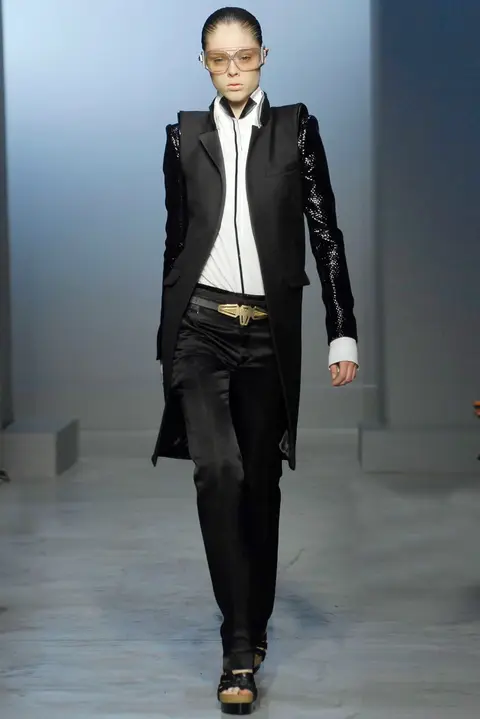
- Articulated Sequined Sleeve Carapace
- The high-gloss sequined textile coats the arm in a rigid cylindrical volume that completely overrides natural anatomical curvature. This intense light-refracting surface engages with Baudrillard's theory of the simulacrum by replacing organic texture with a hyperreal synthetic shield. The dense grid of sequins catches the runway lighting to create an illusion of liquid armour. This intervention asserts the body as a post-human canvas engineered for maximum visual interference.
- Geometric Metallic Belt Buckle
- The geometric metallic belt buckle anchors the waist with a stark symmetrical emblem. Engaging with theories of techno-functionalism this piece operates visually like a docking mechanism rather than a traditional closure. The polished gold-tone hardware interrupts the matte black suiting with clinical precision. This accessory completes the silhouette by injecting industrial machinery directly into the central axis of the body.
- Transparent Polyurethane Visor
- The transparent polyurethane visor wraps horizontally across the upper face to obscure the ocular zone. This optical shielding activates surveillance theory by rendering the wearer simultaneously hyper-visible and anonymous. The clear polymer frame sits aggressively away from the brow bone. The accessory asserts a prosthetic logic that demands a mediated interaction with the environment.
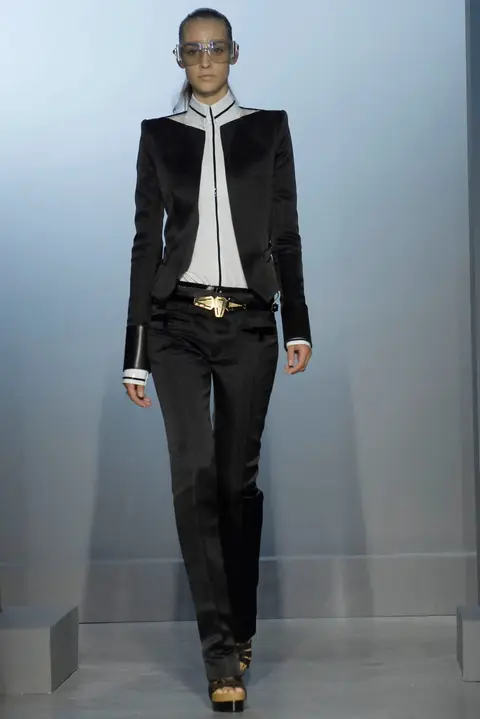
- Rigid Contrast Cuff Extension
- The rigid contrast cuff extension protrudes bluntly from the wrist line to extend the arm's geometry. This deliberate elongation engages with post-human theories regarding bodily borders and limits. The glossy black cylinder terminates in a sharp white band that mimics robotic jointing. This detail refuses classical tailoring proportions to assert a mechanized modularity.
- Geometric Metallic Belt Buckle
- The geometric metallic belt buckle interrupts the monochromatic suiting with a harsh structural focal point. This hardware application invokes cybernetic concepts of the plugged-in body. The angular gold and silver facets reflect the surrounding light intensely. The element completes the garment's architecture by serving as a visual linchpin for the severe planar logic of the torso.
- Transparent Polyurethane Visor
- The transparent polyurethane visor creates a distinct barrier between the face and the observer. This protective eyewear engages directly with techno-political paradigms of environmental hostility. The thick translucent arms grip the skull tightly behind the ears. This shielding asserts a necessary defensiveness within the collection's hyper-modern landscape.
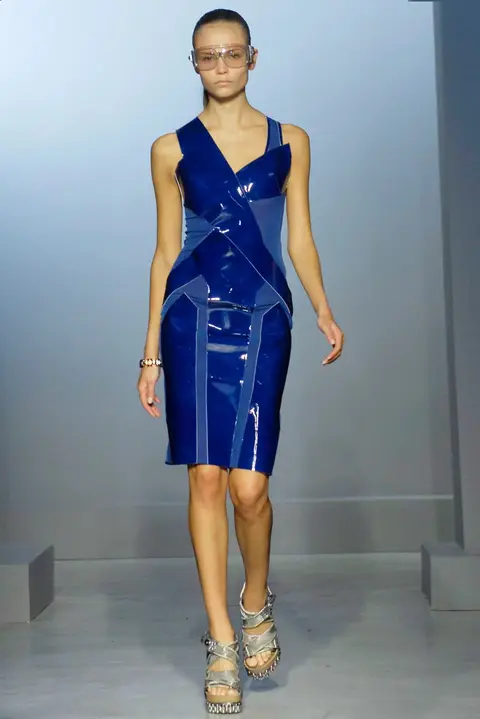
- High-Gloss Polyurethane Paneling
- The high-gloss polyurethane paneling constructs a rigid exterior shell via intersecting diagonal seams. This material strategy invokes post-humanist ideals of the engineered body. The brilliant blue synthetic coating reflects light sharply off the flat planar sections over the bust and hips. The garment refuses traditional drape to assert an unyielding geometric carapace.
- Articulated Industrial Sandal Hardware
- The articulated industrial sandal hardware binds the ankle and foot in a complex network of silver metallic strapping. This heavy footwear directly applies Haraway's Cyborg Manifesto by merging high fashion with extreme athletic technology. The thick buckles and riveted bands mimic snowboarding bindings precisely. This prosthetic extension completes the look by grounding the sleek dress with aggressive mechanical weight.
- Transparent Polyurethane Visor
- The transparent polyurethane visor standardizes the model's gaze beneath a curved synthetic lens. This framing device engages with theories of digital identity by erasing organic facial nuance. The clear material sits starkly against the bare skin. The eyewear asserts a uniform code of anonymity across the collection.
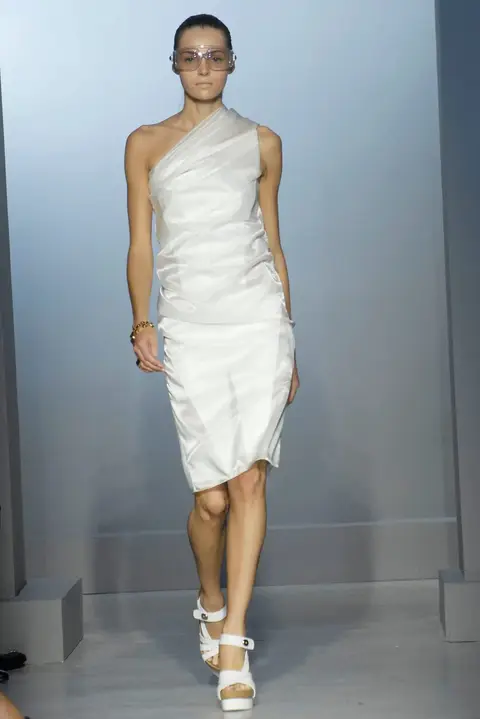
- Asymmetrical Draped Bodice
- The asymmetrical draped bodice manipulates a bright white technical fabric into tight diagonal folds across the chest. This method engages with classical statuary aesthetics while corrupting them through synthetic materials. The high-sheen textile wraps sharply from one shoulder down to the opposing hip. The construction refuses romantic softness to assert a highly calculated tension over the anatomy.
- Transparent Polyurethane Visor
- The transparent polyurethane visor imposes an alien geometry upon the upper half of the face. This hardware engages with concepts of hyperreality by filtering the wearer's vision through industrial plastic. The severe lines of the goggles contrast sharply with the draped white fabric below. This element completes the silhouette by transforming a minimalist dress into a piece of protective gear.
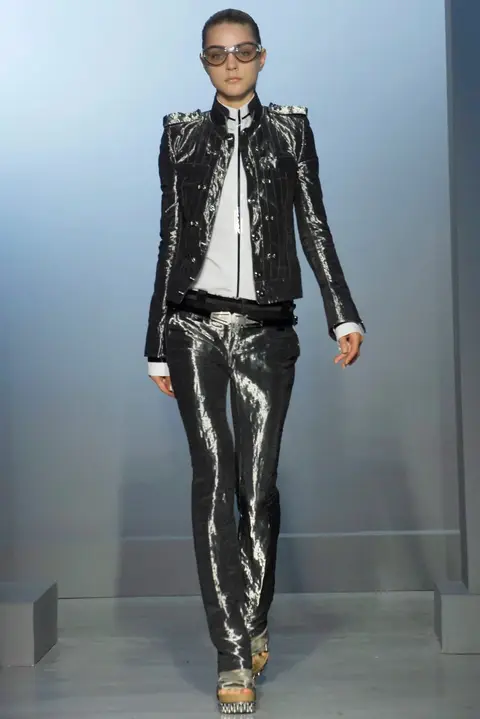
- Liquid Metallic Trouser Textile
- The liquid metallic trouser textile cloaks the legs in a highly reflective crinkled material. This surface treatment engages with Baudrillard's hyperreality by simulating a state of constant fluidity. The stark silver highlights warp dramatically over the knee and thigh as the body moves. The trousers assert a synthetic vitality that supersedes the organic skin beneath.
- Structured Metallic Epaulette
- The structured metallic epaulette extends the shoulder line horizontally with a rigid boxy mass. This architectural shielding engages with the politics of space by physically widening the wearer's footprint. The textured silver fabric is heavily reinforced to maintain its sharp angles. This planar distortion completes the jacket by instilling an aggressive militaristic posture.
- Geometric Metallic Belt Buckle
- The geometric metallic belt buckle bisects the high-shine garments with an injection of solid hardware. This central anchor invokes theories of the machine-body interface. The matte metallic finish contrasts with the liquid texture of the surrounding fabric. This detail refuses the chaotic crinkle of the textile to assert clinical control at the waist.
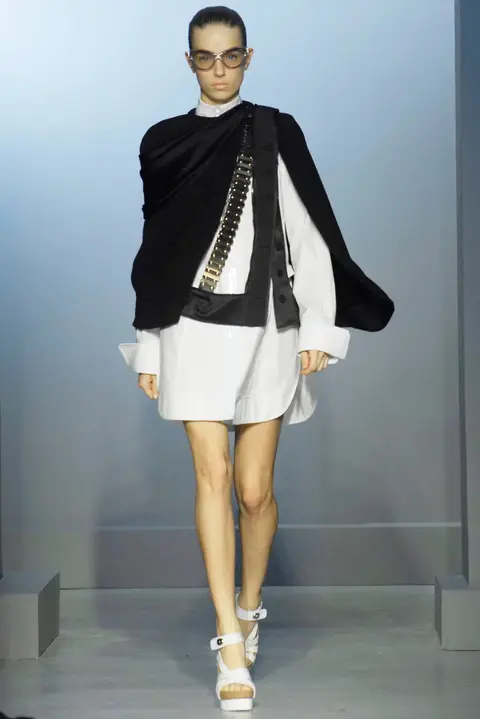
- Studded Diagonal Cross-Body Harness
- The studded diagonal cross-body harness bisects the stark white tunic with a heavy industrial strap. This utilitarian intervention invokes theories of techno-politics by referencing military tactical gear. The gold metallic hardware lines the thick black webbing with aggressive symmetry. The element refuses decorative softness to assert a posture of disciplined readiness.
- Oversized Folded Cuff
- The oversized folded cuff hangs stiffly from the wrist to enlarge the hand's silhouette dramatically. This distortion of scale engages with theories of prosthetic extension. The stark white fabric holds a sharp crease that mimics paper architecture. The cuff completes the severe geometry of the upper body by terminating the sleeve with an unyielding block.
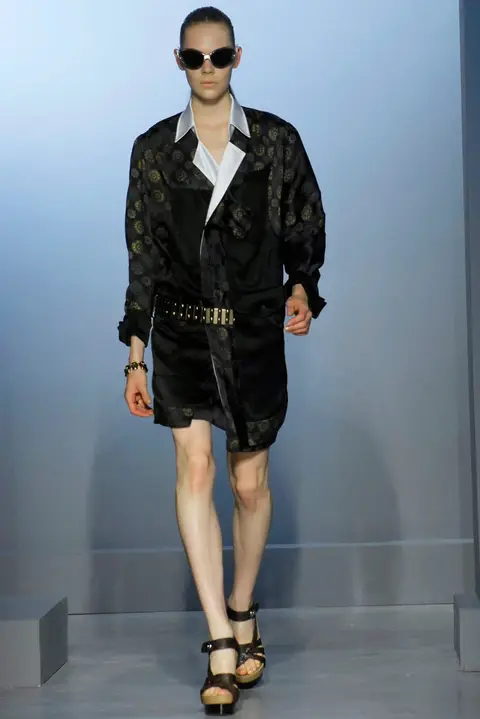
- Woven Geometric Brocade Textile
- The woven geometric brocade textile covers the jacket with dense intersecting circular patterns. This dense surface mapping engages with digital theories of pixelation and grid structures. The muted olive and black tones create a camouflage-like visual noise. The material asserts a retro-futurist logic by applying archaic weaving techniques to cybernetic aesthetics.
- Opaque Black Shield Visor
- The opaque black shield visor completely redacts the wearer's eyes behind a solid synthetic barrier. This total ocular denial invokes extreme forms of surveillance evasion. The dark curved lenses sit heavily upon the cheekbones. The accessory refuses eye contact to assert the wearer as an impenetrable autonomous unit.
- Geometric Metallic Belt Buckle
- The geometric metallic belt buckle tightly cinches the busy patterned jacket to define the waist. This hardware piece functions as a theoretical anchor point for the simulated body. The heavy metal squares interrupt the soft drape of the fabric forcefully. The element completes the look by linking the traditional garment back to the industrial themes of the collection.
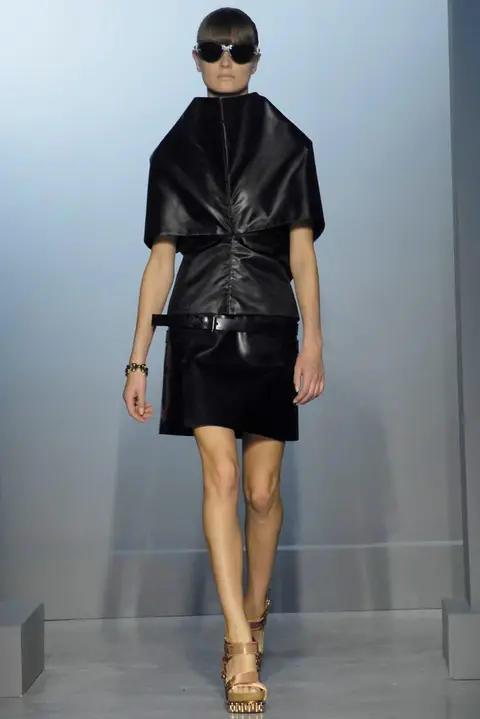
- Rigid Architectural Shoulder Carapace
- The rigid architectural shoulder carapace extends laterally to disguise the natural slope of the clavicle. This volumetric expansion relies on internal scaffolding to engage with theories of architectural shielding. The stark black synthetic fabric is pulled taut over unseen structural supports. This geometric abstraction completes the upper silhouette by transforming the human torso into an imposing spatial monolith.
- High-Gloss Polyurethane Skirting
- The high-gloss polyurethane skirting drops straight down from the waist with minimal drape. This application of synthetic polymer engages with theories of corporeal containment. The dense black material reflects light purely as structural highlights rather than soft texture. The garment refuses traditional movement to assert a strictly controlled lower body silhouette.
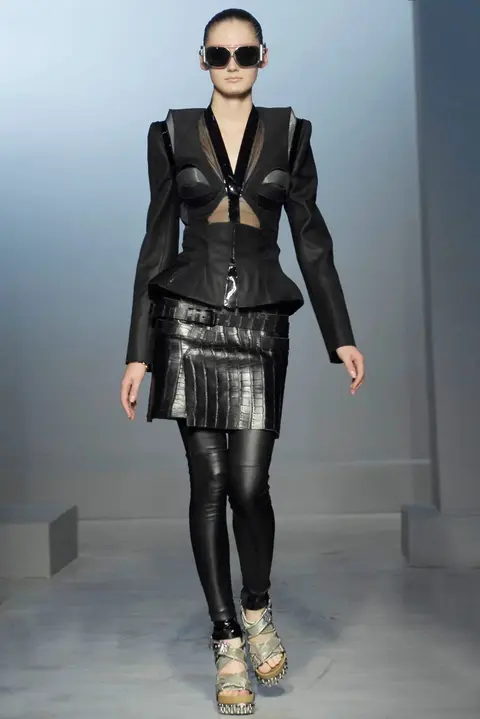
- Exaggerated Molded Hip Peplum
- The exaggerated molded hip peplum protrudes sharply from the natural waistline in a rigid geometric shelf. This severe planar distortion engages with feminist critiques of bodily regulation by creating an impossible hyper-structured silhouette. The thick black textile maintains its cantilevered position without visible external support. This structural extremity asserts the supremacy of the garment's architecture over the organic human form beneath.
- Rigid Architectural Shoulder Carapace
- The rigid architectural shoulder carapace vaults upward in aggressive triangular points. This internal scaffolding invokes the concept of defensive biological armour. The matte fabric stretches tightly across these jutting peaks. The construction completes the hourglass geometry by forcibly mirroring the jutting hips below.
- Segmented Polyurethane Skirting
- The segmented polyurethane skirting layers horizontal panels of croc-embossed synthetic material. This segmentation mimics reptilian scales to engage with post-human ideas of interspecies splicing. The glossy panels overlap neatly without fluid movement. This intervention asserts a hard tactile barrier over the thighs.
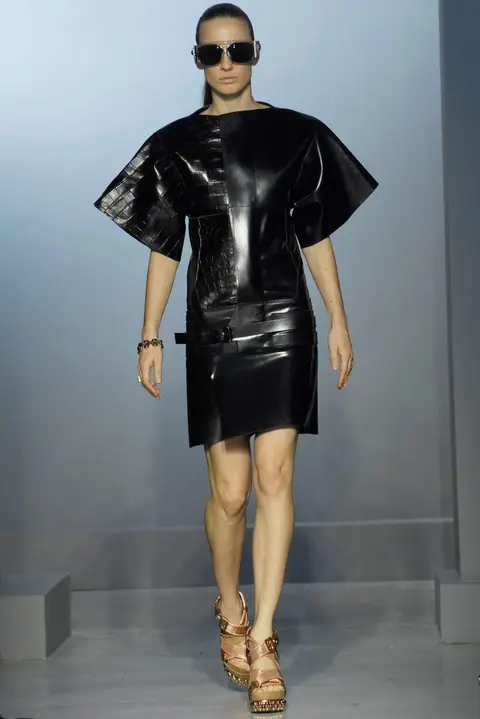
- Croc-Embossed Asymmetrical Paneling
- The croc-embossed asymmetrical paneling fuses organic animal textures with severe industrial tailoring. This material hybridity engages heavily with Haraway's ideas of the chimeric cyborg. The high-gloss faux-leather sections meet matte black fabric at sharp linear intersections across the chest. The design refuses symmetrical balance to assert an unpredictable morphological layout.
- Segmented Polyurethane Skirting
- The segmented polyurethane skirting wraps the hips in tight restrictive horizontal bands. This structural logic mimics mediaeval plate armour updated in petroleum-based polymers. The wide leather belt mechanism locks the top tier firmly into place. The garment completes the silhouette by enforcing absolute rigidity at the core of the body.
- Opaque Black Shield Visor
- The opaque black shield visor dominates the facial landscape with a thick unreflective black surface. This accessory activates themes of architectural shielding against constant surveillance. The stark black frame creates a severe horizontal line across the brow. This piece asserts ultimate detachment from the spectator.
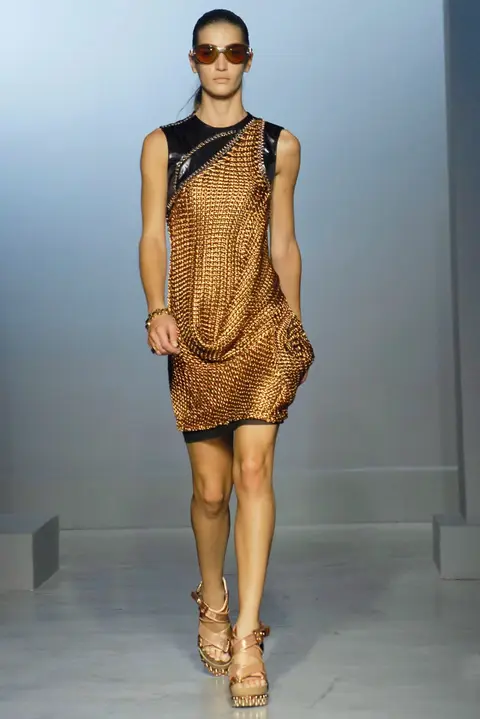
- Draped Metallic Chainmail Textile
- The draped metallic chainmail textile wraps the torso in a fluid but heavy industrial skin. This material application engages with corporeal interventions by treating armour as a malleable second skin. The gold links catch individual points of light as they slump heavily across the hip and bust. The textile asserts a retro-futurist heritage by fusing medieval defensive construction with disco-era glamour.
- Asymmetrical Contrast Shoulder Strap
- The asymmetrical contrast shoulder strap cuts diagonally across the clavicle in solid black leather. This sharp structural line interrupts the fluid drape of the chainmail. Engaging with deconstructivist principles the strap appears to arbitrarily anchor the heavy metallic mass. This detail completes the dress by injecting a harsh geometric focal point into the organic folds.
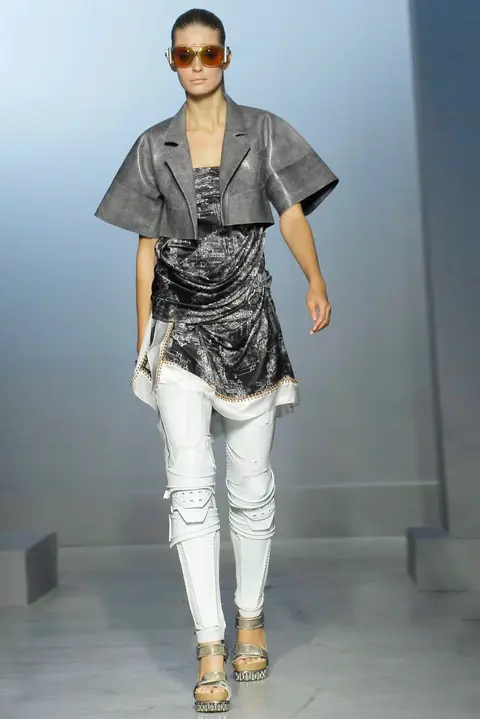
- Segmented Prosthetic Leg Armour
- The segmented prosthetic leg armour encases the lower limbs in articulated white polymer panels. This extreme structural addition directly channels Haraway's Cyborg Manifesto by physically merging human anatomy with robotic componentry. The distinct mechanical joints sit visibly over the knee and shin to mimic external exoskeletal supports. This configuration completely refuses traditional hosiery in favour of militarized techno-politics.
- Digital Schematic Print Top
- The digital schematic print top features a chaotic matrix of circuit-board-like patterns stretching across the draped textile. This specific graphic application engages with media theory regarding the corporeal absorption of data. The intricate grey and white lines distort over the physical folds of the torso. The garment asserts the female body as an active node within a sprawling digital network.
- Transparent Polyurethane Visor
- The transparent polyurethane visor shields the eyes behind a tinted yellow lens. This visual filter invokes theories of hyperreality where the environment is constantly colour-corrected. The heavy polymer arms lock securely over the ears. The accessory completes the mechanized aesthetic by equipping the wearer with specialized sensory hardware.
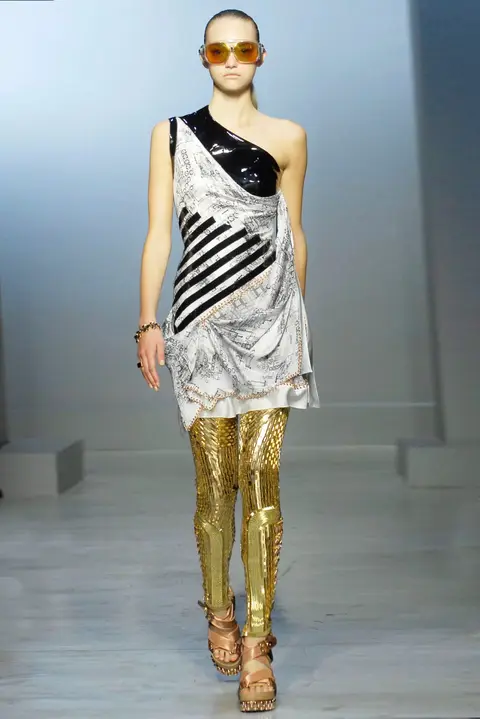
- Segmented Prosthetic Leg Armour
- The segmented prosthetic leg armour coats the legs in high-shine gold metallic plating. This literal mechanization of the limb engages directly with post-humanist visions of the augmented body. The articulated plates overlap tightly from thigh to ankle to allow movement while maintaining a rigid robotic facade. The component completes the collection's vision of the futuristic soldier navigating a hyperreal landscape.
- High-Gloss Asymmetrical Chest Panel
- The high-gloss asymmetrical chest panel overlays the schematic print with a slab of solid black polyurethane. This dark planar insertion engages with architectural theories of void spaces on the body. The shiny wet-look material creates a stark textural contrast against the soft white draping. This element refuses structural balance to assert a fractured and modular silhouette.
- Transparent Polyurethane Visor
- The transparent polyurethane visor glazes the upper face with an amber-tinted curvature. This synthetic modification of sight invokes Baudrillard's concepts of the mediated gaze. The thick rimless edge sits dangerously close to the cheek. The eyewear completes the look by fully integrating the head into the technological apparatus of the garments.
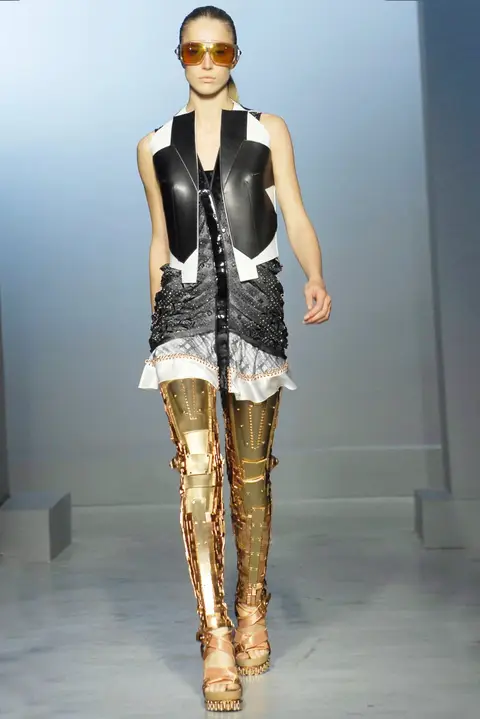
- Rigid Leather Vest Armature
- The rigid leather vest armature clamps over the torso with heavy black panels and wide lapels. This structural shell functions as an external carapace linking fashion directly to industrial design logic. The thick material sits away from the body to create artificial volume at the shoulders. The piece asserts a defensive posture by shielding the delicate printed silk beneath.
- Segmented Prosthetic Leg Armour
- The segmented prosthetic leg armour constructs an entirely metallic silhouette for the lower half of the body. Engaging with cyborg feminism this hardware physically overwrites the organic flesh. The interconnected golden plates reflect the runway lights brilliantly off every mechanical joint. This extreme bodily intervention completely refuses the concept of bare skin.
- Transparent Polyurethane Visor
- The transparent polyurethane visor caps the ensemble with its signature protective framing. This continuous motif across the collection reinforces the techno-political theme of constant surveillance. The clear amber lens provides a minimal barrier without sacrificing aesthetic aggression. The visor asserts the absolute necessity of headgear in this synthetic future.
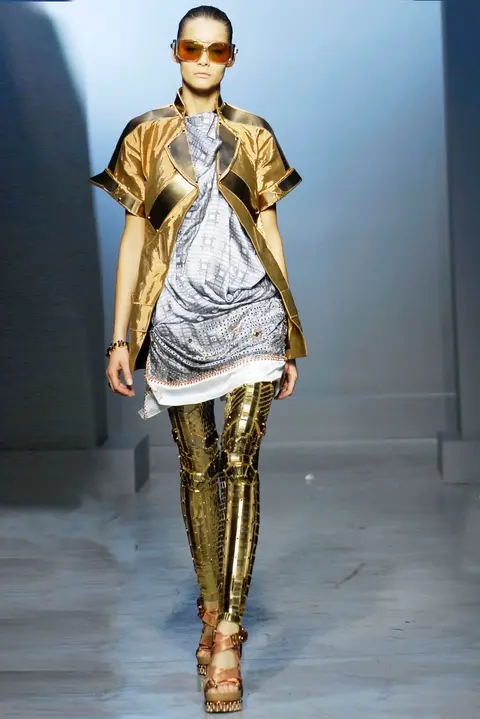
- Geometric Metallic Outerwear Shell
- The geometric metallic outerwear shell wraps the upper body in sharp golden facets. This boxy garment engages with architectural theories of the habitable structure. The stiff metallic fabric is creased heavily to create rigid lines that jut away from the chest and arms. This planar distortion completes the torso by encasing it in a brilliant defensive volume.
- Segmented Prosthetic Leg Armour
- The segmented prosthetic leg armour dominates the lower visual field with its complex interlocking gold machinery. This literal application of prosthetic extension transforms the model into a fully integrated machine-organism. The heavy riveted plates align perfectly with the knee and ankle joints to maintain locomotion. The armour asserts the absolute triumph of synthetic engineering over the vulnerability of the natural body.
Photographs: Marcio Madeira, via Vogue Runway. Reproduced for criticism and review under CDPA 1988 s.30.
Quick facts
- Era
- 2000 to 2009; The Global Conglomerate Era
- Politics
- Techno-Politics & Digital Identities
- Theories
- Cyborg Manifestos (Haraway)
- Form & anatomy
- Prosthetic Extension
- Materials
- Industrial Coatings
- Geography
- Paris (Chambre Syndicale)
- Gender
- Womenswear
- Format & medium
- Traditional Runway