THE LEXICON / Fashion vs. fashion
Miguel Adrover AW 2000Midtown
Miguel Adrover held an underground show in New York using old, thrown-away clothes, including a coat made from his late neighbour's stained mattress. It made people ask who decides what counts as luxury, and what counts as rubbish.
Provenance
Miguel Adrover's monumental Fall/Winter 2000 'Midtown' collection — his second-ever runway show — catapulted him to sudden stardom. Staged during New York Fashion Week, the show operated as a purely underground DIY event: it was held at the Clemente Soto Vélez Cultural Center on the Lower East Side, completely off-schedule, with entry passes consisting of one-dollar bills stamped with the venue's address. The presentation was a massive critical success — Adrover was labeled 'New York's New Star' on the cover of Women's Wear Daily and eventually won the CFDA Perry Ellis Award for Emerging Talent. However the rebellious nature of his designs immediately sparked corporate backlash; Burberry threatened a lawsuit demanding Adrover never use their plaid patterning again.
Critique
During an era dominated by corporate fashion conglomerates and an obsession with polished logo-heavy luxury, Adrover's collection served as a sharp critique of capitalist consumerism and fashion's growing homogeneity. By illegally appropriating the ultimate status symbols of the time (Burberry, Louis Vuitton), he hijacked their cultural cachet while simultaneously mocking the industry's logo-mania. Adrover actively championed imperfection, decay, and raw honesty — by transforming the stained abandoned mattress of Quentin Crisp into a beautifully tailored garment, he elevated urban detritus into poetic invention, proving that the histories, memories, and physical wear embedded within an object hold more profound value than pristine mass-produced commercial clothing. The collection functioned as a love letter to the gritty reality of downtown New York City culture — the juxtaposition of European luxury goods with the ubiquitous working-class NY Yankees cap highlighted the contrasting socio-economic realities of the city, celebrating the authentic street style and rampant bootleg culture of the era. Long before sustainability became an industry buzzword, Adrover was a trailblazer for circular design, operating under severe financial constraints and turning those limitations into a profound strength by proving that luxury upcycling could yield garments worthy of high-fashion runways and museum archives.
Strategy
Adrover's core structural methodology was the radical repurposing and upcycling of preexisting garments — a technique directly compared to Marcel Duchamp's readymades and Robert Rauschenberg's combine paintings. He integrated discarded everyday objects and iconic luxury pieces from his urban environment directly into his clothing compositions. Adrover engineered new avant-garde silhouettes by slicing up hyper-recognizable luxury goods: he famously took a classic Burberry trench coat and reconstructed it inside-out and backwards to create a plaid dress, and dismantled a Louis Vuitton bag to craft a miniskirt. He utilized distinctly non-fashion items to build the internal architecture of his garments — most notably using New York Yankees baseball caps as structural shoulder pads beneath a navy sweater. He also deconstructed two pairs of trousers, resewing one pair into a cropped jacket paired with Hermès belts. The collection's most poignant and famous piece was a tailored striped overcoat constructed entirely out of a discarded stained mattress that had belonged to Adrover's recently deceased neighbor, the famous queer writer and raconteur Quentin Crisp; Adrover distressed the fabric further by burning it on a stove in his East 3rd Street basement.
Looks
- Reappropriated Burberry Check Overcoat
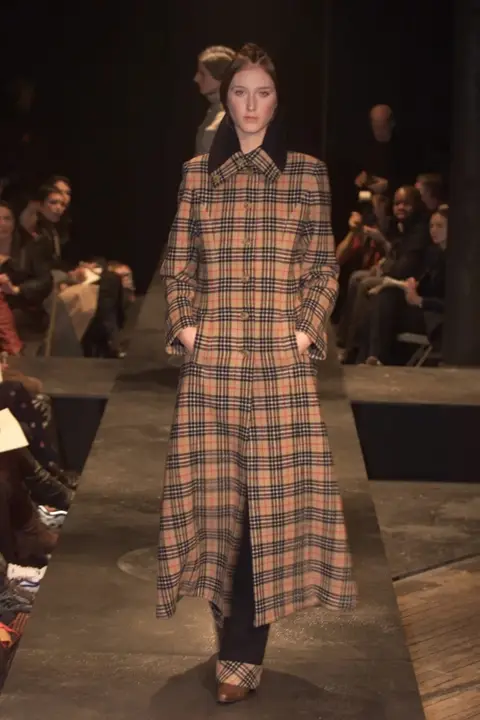
- The reappropriated Burberry check overcoat wraps the torso in the house's own camel, black, and red tartan, worn open over a black turtleneck with both hands driven into the pockets. This is among the literal artifacts the collection is remembered for: Adrover sourced and rebuilt an actual Burberry trench, detaching its trademarked pattern from licensed circulation and returning it to raw material. The gesture enacts symbolic exchange in Baudrillard's sense, hijacking a heritage house's status-signalling code without permission — a provocation pointed enough that Burberry itself threatened legal action. Read against the collection's anti-consumerist politics, the coat functions less as theft than as institutional critique made wearable.
- Matching Check Trouser Cuffs and Pumps
- Beneath the coat's long hem, cuffs of the same appropriated check peek out above simple brown pointed pumps, extending the hijacked Burberry pattern from outerwear down to the ankle rather than isolating it to a single showpiece. The deliberately unremarkable footwear keeps visual emphasis on the stolen textile itself. There is no additional spectacle competing with the pattern's own recognisability. This continuity across the whole silhouette underlines Adrover's guerrilla methodology of total reconstruction from a single sourced luxury good, worn with the same deadpan confidence as any ordinary ready-to-wear coat and trouser combination.
- Oversized Bouclé Knit Wrap Cardigan
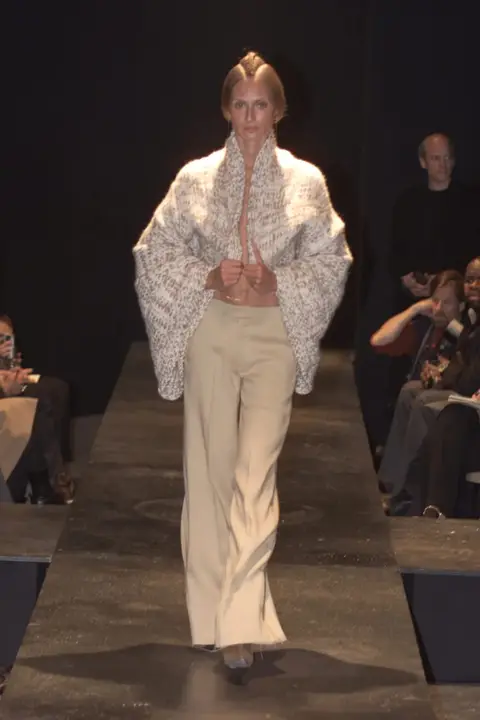
- The oversized bouclé knit wrap cardigan swallows the upper body in a dense oatmeal and grey knit, its collar rising into an exaggerated funnel shape and its sleeves ballooning into vast dolman volumes. Left unfastened but for a single hook, it falls open to expose the bare midriff beneath. This relaxed, domestically-textured knitwear draws on found and surplus materials rather than couture fabrication, consistent with the collection's reliance on deadstock and upcycled textiles. The garment's soft, oversized bulk refuses the era's body-conscious tailoring, asserting a comfort-driven, almost blanket-like informality against the polished corporate silhouettes the collection was staged to critique.
- High-Waisted Cream Wide-Leg Trousers
- The high-waisted cream wide-leg trousers drop in a fluid, undyed wool from just below the exposed midriff to the floor, their frayed unfinished hems dragging loosely over simple pointed pumps. Cut without a defined crease or dart, the trousers rely on soft volume rather than tailoring precision, extending the cardigan's relaxed informality into the lower body. The pale, unbleached tone reads as a deliberately raw, unfinished material choice, in keeping with the collection's broader commitment to visible imperfection and reclaimed textile honesty over polished mass-produced consistency.
- Windowpane Check Overcoat over Ribbed Turtleneck
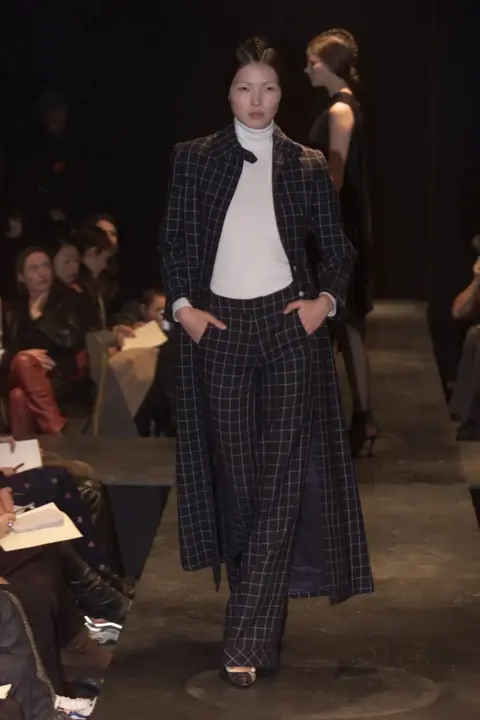
- The windowpane check overcoat structures the torso in a fine black-and-white grid, worn open over a chunky ribbed ivory turtleneck and closed at a single button beneath the collarbone. The model's hair is worked into tight cornrows pulled back from the face. The coat's fine graphic check nods toward corporate tailoring codes without fully complying with them — the garment hangs open and unstructured rather than buttoned into formal discipline. This half-compliance with businesswear enacts the collection's broader subversion of Wall Street polish into something looser and more downtown.
- Matching Windowpane Check Wide-Leg Trousers
- The matching windowpane check wide-leg trousers continue the coat's fine black-and-white grid down the body, cut with a wide, unrestrictive leg that pools slightly at the ankle over pointed heels. The exact pattern match between coat and trouser gives the look the appearance of a single continuous fabric rather than a coordinated separate suit, collapsing the traditional distinction between outerwear and tailoring into one unbroken graphic surface — a quietly rigorous exercise in pattern discipline within an otherwise loosely constructed silhouette.
- Draped Camel Kaftan with Dolman Sleeves
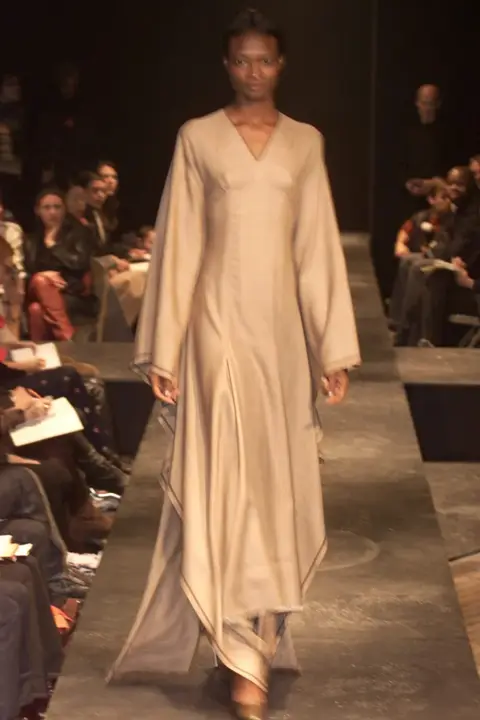
- The draped camel kaftan falls from a deep V-neckline in dolman sleeves so wide they read as a single continuous plane of fabric from wrist to hem. The loosely woven, undyed wool traps and releases light unevenly across its surface. This unstructured, single-seam construction abandons Western tailoring's reliance on darts and princess seams in favour of a wrapped, non-fitted drape borrowed from non-Western dress traditions. Consistent with the collection's ecological politics, the raw, minimally processed textile foregrounds the visible labour and material honesty of the weave itself over a polished finished surface.
- Frayed Asymmetric Hem with Sheer Underlayer
- At the hem, the kaftan's fabric splits into an asymmetric double layer, its raw edges left visibly frayed and unhemmed where a sheer underlayer of the same camel tone shows through against the model's bronze pumps. The deliberate refusal to finish the hem — rather than concealing the fraying as a construction flaw — turns unraveling cloth into a stated aesthetic position: imperfection, wear, and rawness are treated as more valuable than the seamless finish of pristine mass-produced clothing.
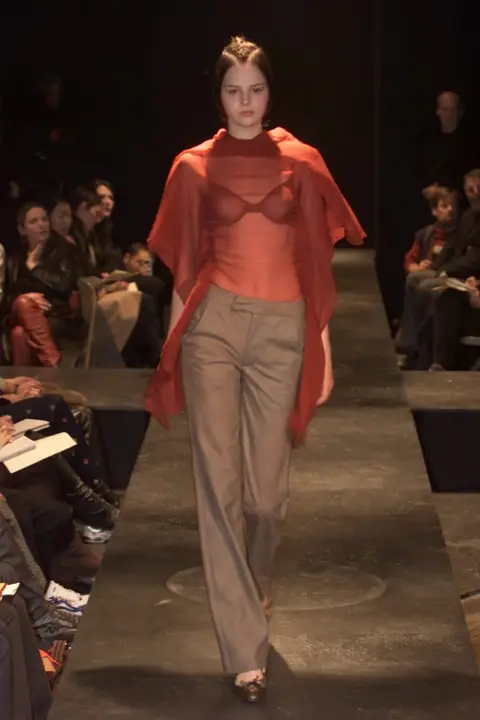
- Sheer Rust Draped Overlay
- A sheer rust-orange overlay drapes asymmetrically across the shoulders and chest like an improvised stole, its diaphanous weave revealing the fitted knit top and undergarments beneath. The fabric falls unevenly, longer on one side than the other, with no visible closure holding its position. This provisional, half-tied styling — cloth draped rather than cut and seamed to the body — treats garment construction as an ongoing, informal gesture rather than a fixed engineering problem, in keeping with the collection's downtown, DIY sensibility.
- Khaki Wide-Leg Trousers
- The khaki wide-leg trousers drop in an unstructured woven wool from the natural waist to the floor, their wide leg swinging loosely with the model's stride and pooling slightly over simple metallic-buckled flats. The muted, workwear-adjacent khaki tone grounds the sheer rust drape above in something plainer and more utilitarian, echoing the collection's recurring juxtaposition of humble, working-class fabrics against more fragile or elevated textiles layered on top.
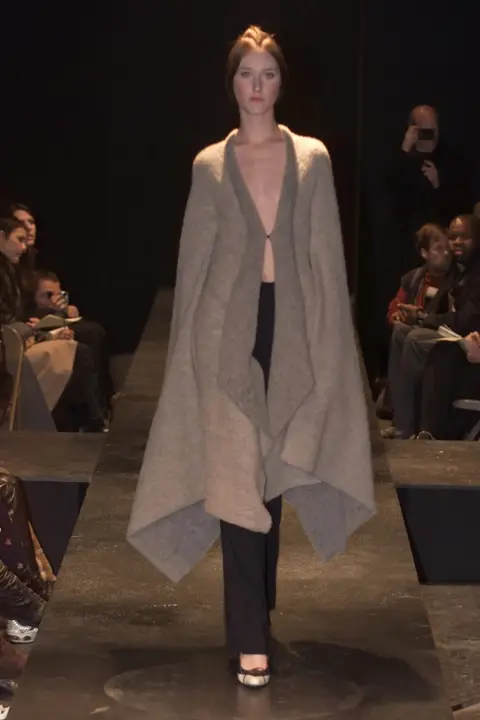
- Draped Wool Wrap Cape, Open to the Waist
- The draped wool wrap cape falls from the shoulders in an enormous unstructured triangle of soft grey-beige bouclé, its two front panels crossing loosely and fastened by a single small hook well below the collarbone, leaving the chest bare beneath. The cape's scale — pooling in deep folds well past the hips — treats the wearer's body as a mere armature for an oversized textile event rather than the reverse. Construction subordinates itself entirely to the raw material's own drape and weight.
- Black Trousers and Two-Tone Pumps
- Beneath the cape's sweeping hem, plain black trousers and simple black-and-white two-tone pumps offer the only structured, tailored element in an otherwise engulfing silhouette. Their quiet, almost invisible presence is the point: with virtually the entire visual field given over to the oversized cape above, the trousers exist purely as a practical, unremarkable base that lets the raw wool volume above read as the look's sole event.
Look 7 not shown here. Content note: Nudity (sheer dress).
- Sheer Sequin-Embroidered Caftan
- The foreground model wears a sheer caftan densely embroidered with scattered metallic sequins across an olive-toned net ground, its dolman sleeves and unfitted body allowing the light beneath to catch each sequin individually as she walks. The weave is sheer enough to reveal the body's silhouette entirely beneath the glittering surface. This exposed, unlined transparency abandons the era's tendency toward polished eveningwear opacity, instead offering a raw, handcrafted density of embellishment against the runway's low light.
- Cream Asymmetric Slip Dress, Seen from Behind
- Behind her, a second model walks away from camera in a pale cream slip dress cut on the bias, its uneven hem dropping into a raw, frayed point at one hip while the opposite side rises to mid-thigh. Her hair is worked into an elaborate braided updo pinned high off the neck. Seen only from behind, the dress's asymmetric hem and visible spine seam read as sculptural rather than merely decorative, emphasising construction over the more conventional frontal presentation typical of eveningwear.
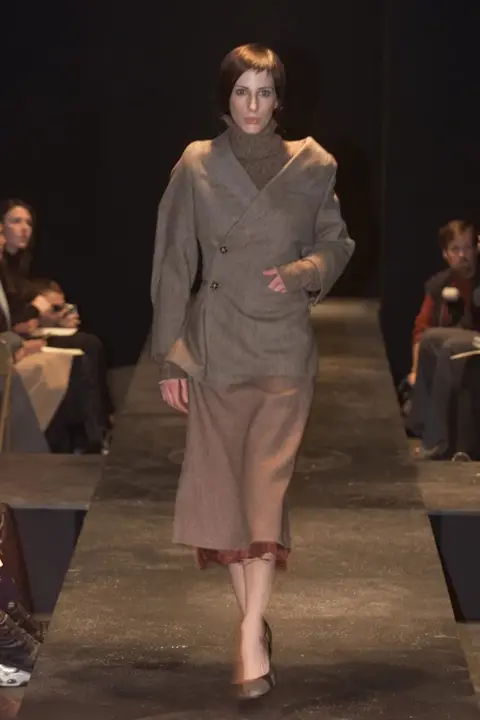
- Herringbone Wrap Jacket with Wide Lapels
- The herringbone wrap jacket crosses the torso in a soft brown-and-grey woven wool, its wide asymmetric lapel folding diagonally over a chunky ribbed brown turtleneck and closing low on the hip with two dark buttons. Cut from a heavier mid-century-coded tailoring cloth but assembled with a loose, wrapped closure rather than a fitted set of darts, the jacket borrows the visual authority of traditional menswear tweed while refusing its precision, softening a formal textile into something more improvised.
- Brown Tweed Pencil Skirt
- The brown tweed pencil skirt drops in the same herringbone weave as the jacket above, falling in a straight, narrow column to the mid-calf where a contrasting rust-red underlayer peeks out beneath its raw hem. The skirt's narrow cut is the only strictly tailored element in the look, offsetting the jacket's looser wrapped construction with a single note of conventional discipline, while the glimpsed red lining beneath introduces an unexpected, half-hidden flash of colour into the otherwise monochrome tweed.
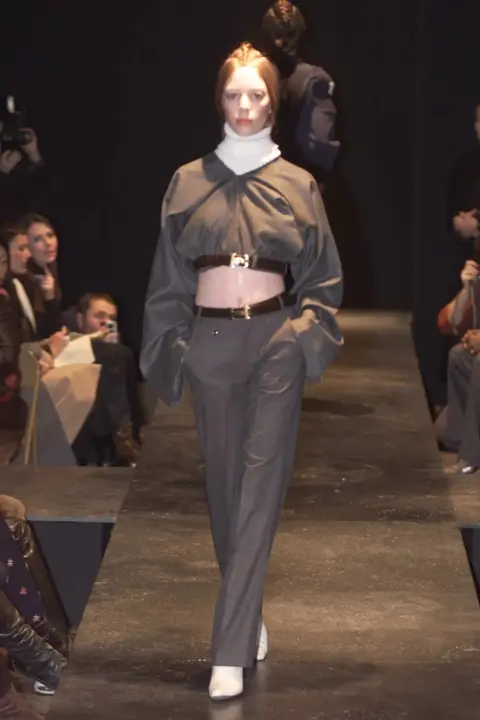
- Cropped Blouse Cinched by Stacked Belts
- The cropped taupe blouse billows into wide gathered sleeves before being cinched sharply at the ribcage by two stacked leather belts, their gold buckles pulling the loose fabric into a tight horizontal band well above the natural waist and exposing the bare midriff beneath a white ribbed turtleneck collar. This is the garment the collection is remembered for pairing with genuine Hermès belt hardware: rather than treating the belts as mere waist accessories, Adrover uses them as the primary structural device holding the entire blouse's volume in place, collapsing the distinction between accessory and construction method.
- Grey Wide-Leg Trousers and White Boots
- Below the cinched blouse, grey wide-leg trousers fall in a soft wool from the belted waistline to the floor, breaking cleanly over pointed white ankle boots. The trousers' wide, unfitted cut continues the collection's preference for loose lower-body volume even where the upper body has been tightly bound, so that the belts' constriction reads as an isolated event rather than a total-body silhouette strategy.
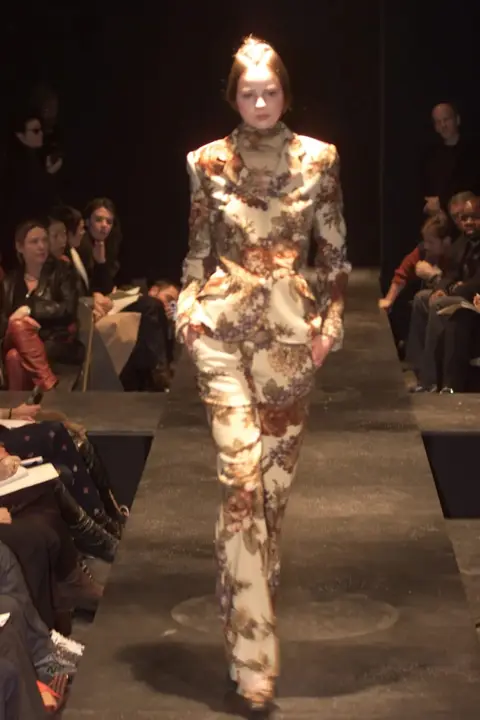
- Floral-Printed Tailored Blazer
- The floral-printed tailored blazer covers the torso in a dense rust, olive, and cream botanical print rendered across structured menswear-cut lapels and shoulders, worn over a matching white ribbed turtleneck with both hands pushed into the pockets. Applying an unmistakably decorative, almost upholstery-coded print to a rigorously tailored menswear silhouette collapses the usual distinction between hard corporate tailoring and soft domestic textile, a pastiche move consistent with the collection's habit of dressing formal structures in unexpectedly informal cloth.
- Matching Floral-Printed Trousers
- The matching floral-printed trousers extend the blazer's dense botanical pattern down the entire leg in a single continuous print, breaking cleanly at the ankle over simple pale pumps. The exact match between jacket and trouser gives the look the unbroken quality of a single printed textile wrapped around the body rather than a coordinated separate suit, intensifying the pastiche of applying a soft floral print to the rigid structure of matching tailored separates.
Photographs: JB Villareal / Shoot Digital, via Vogue Runway. Reproduced for criticism and review under CDPA 1988 s.30.
Quick facts
- Era
- 2000 to 2009; The Global Conglomerate Era
- Politics
- Anti-Consumerism & Institutional Critique, Class Dynamics & Anti-Elitism, Queer Theory & Subcultural Systems, Ecological Politics & Resource Extraction
- Theories
- Symbolic Exchange, Camp and Kitsch Subversion, Subcultural Resistance Theory, Marxist Materialism
- Form & anatomy
- Deconstructed Assembly, Surface Erosion and Degradation, Modular Componentry
- Materials
- Upcycled Industrial Waste, Deadstock & Surplus Inventory, Plant-Based Cellulose, Domestic Found Objects
- Geography
- New York (CFDA/NYFW)
- Gender
- Womenswear
- Format & medium
- Guerrilla / Street Presentation