THE LEXICON / Changing the body
Alexander McQueen SS 1999No. 13
McQueen sent a Paralympic athlete down the runway on carved wooden legs, then had robots spray-paint a dress live. It made people ask what a 'perfect' body is.
Provenance
Alexander McQueen presented his thirteenth runway show, simply titled No. 13, during London Fashion Week in September 1998 as a Spring/Summer 1999 Ready-to-Wear collection. The show opened with Paralympic athlete and double amputee Aimee Mullins wearing a bespoke pair of wooden prosthetic legs carved from solid ash by Bob Watts of the Dorset Orthopaedic Centre, with intricate decorative carving executed by woodcarver and gilder Paul Ferguson. The prosthetic design was inspired by Louis XIV-style furniture and the period woodcarving tradition of Grinling Gibbons. The show culminated in the now-iconic finale in which model Shalom Harlow, positioned on a rotating platform, had her white strapless gown spray-painted by two industrial robotic arms. The presentation was staged within a warehouse space, its format functioning as a live theatrical and performance art event rather than a conventional runway.
Critique
No. 13 constitutes a foundational document of Post-Humanism in fashion, systematically dismantling the boundary between the biological body and its technological supplement. By placing Mullins on the runway in hand-carved ash prosthetics, McQueen transformed a clinical medical device into a symbolic object of radical self-authorship, directly challenging ableist beauty standards that demand the unmarked, normative physique. The intervention drew an explicit historical parallel between the corset — an orthopaedic device aestheticised into a fashion object — and the prosthetic, proposing both as architectures of corporeal negotiation. The wooden legs, coded simultaneously as grotesque and beautiful, enacted The Subverted Gaze, forcing the audience into an unstable position between desire and uncanny dread. The finale extended this logic into its most violent register: Harlow, stripped of agency on the rotating platform, became the passive subject of a panoptic, non-consensual mechanical assault, her garment destroyed by algorithmic precision. The total sequence positions the human body as a site of perpetual negotiation between biological fragility and technological overwriting.
Strategy
McQueen's structural logic treated the prosthetic not as a medical necessity to be concealed but as a site of highly visible, customised architectural construction. Watts faced the technical challenge of engineering a solid one-block wooden leg with internally carved sockets accommodating Mullins's residual limbs, eliminating the need for external straps while allowing a graceful gait. The external geometry was resolved as a Victorian knee-length boot form, with a Louis heel, slim ankle, and pointed toe. Kinetic movement was solved through clog mechanics, with the sole curved upward at the toe to enable forward roll. In place of lacing, Ferguson carved intricate vines and foliage directly into the surface of the wood. The finale deployed industrial robotics as an agent of aesthetic violence, structuring the destruction of the garment as a live event witnessed in real time by the front row, ensuring immediate editorial dominance and foreclosing any conventional press-release narrative.
Looks
Look 1 not shown here. Content note: Nudity.
- Low Rise Trouser Waist
- The waistband is cut extremely low to reveal the pelvic bone and navel region. This anatomical displacement engages with Body Politics by challenging traditional sites of modesty and tailoring restraint. The structural tension between the heavy wool plaid and the exposed skin highlights a visceral corporeal presence. It refuses the coverage of conventional suiting to emphasize the raw geometry of the torso.
- Open Standing Collar
- The high funnel collar is integrated into the lapel and remains unfastened to frame the neck and sternum. Through Deconstructionist Logic the garment is stripped of its utilitarian closure to reveal the interiority of the silhouette. The sharp vertical lines of the plaid print accentuate the architectural rigidity of the coat. It asserts the jacket as a sculptural frame rather than a protective outer layer.
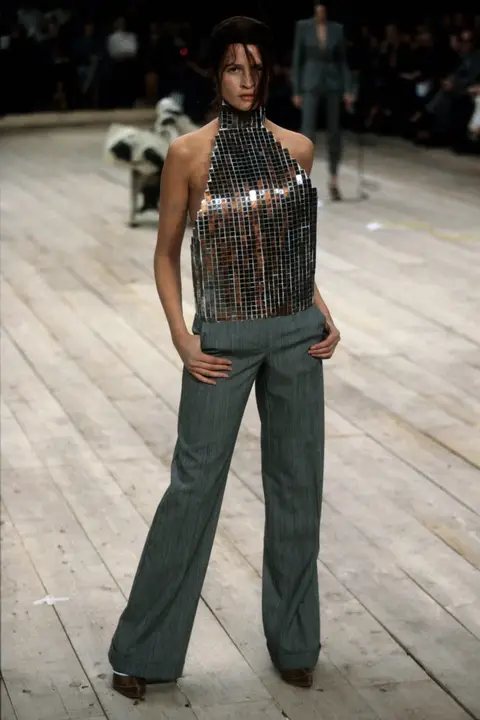
- Mirror Mosaic Halter
- The bodice is constructed from a grid of individual mirrored tiles that create a fragmented reflective surface. This material choice engages with The Simulacrum by reflecting and distorting the environment into a pixelated image. The sharp, geometric edges of the tiles contrast with the organic curves of the human form beneath. It completes the collection's theme of the body as an object of industrial assembly.
- Grey Flared Trousers
- The trousers are tailored with a wide flare from the knee down to create a dramatic architectural base. This extension of the leg engages with Post-Humanism by exaggerating the human proportion into a non-biological silhouette. The heavy fabric provides a grounding weight to the light-reflecting bodice. It asserts a powerful, rooted stance that balances the fragility of the mirrored top.
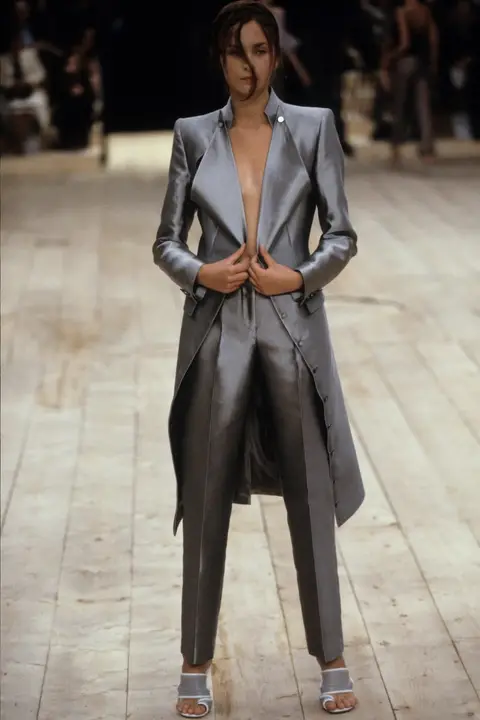
- Silver Metallic Lapel
- The lustrous silver fabric is folded into sharp, precise lapels that capture and diffuse runway lighting. This synthetic sheen engages with Cyborg Manifestos by suggesting a skin composed of liquid metal or futuristic alloys. The clean finish of the tailoring emphasizes a machine-like perfection in the construction. It asserts the garment as a technological skin that mediates the body and the environment.
- Tapered Silver Trousers
- The trousers feature a slim, tapered cut that follows the natural line of the leg while maintaining a rigid, metallic surface. Through the lens of Post-Humanism the uniform materiality of the suit erases the distinction between garment and anatomy. The visible crease down the center of the leg provides a structural spine to the lower half. It completes the vision of a unified, metallicized human subject.
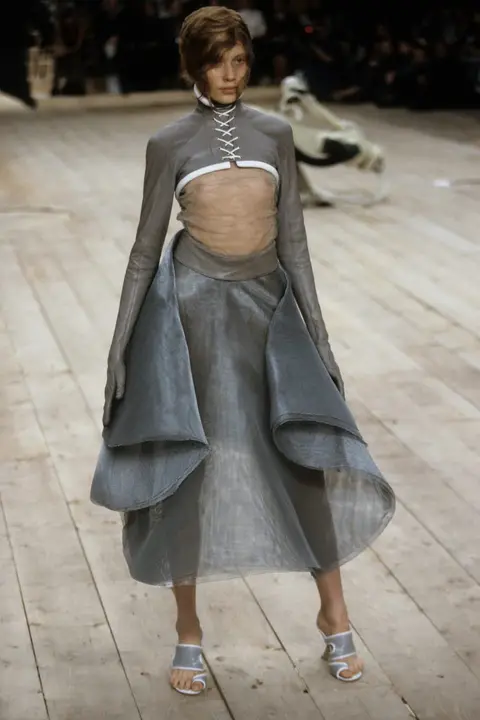
- White Bound Neckline
- The high collar is defined by a thick white border that creates a graphic break against the grey leather. This constriction engages with Body Politics by echoing orthopedic or medical restraints. The visible lacing detail at the throat suggests a surgical or fetishistic tension. It asserts a mood of restricted elegance that defines the upper silhouette.
- Layered Mesh Overskirt
- The skirt is composed of translucent grey mesh panels that create a sense of ethereal, layered volume. This material transparency engages with The Grotesque and Abject by partially revealing the skeletal or limb structure beneath. The lightness of the mesh contrasts with the heavy, bound leather of the torso. It refuses the solidity of traditional skirts in favor of a spectral, atmospheric movement.
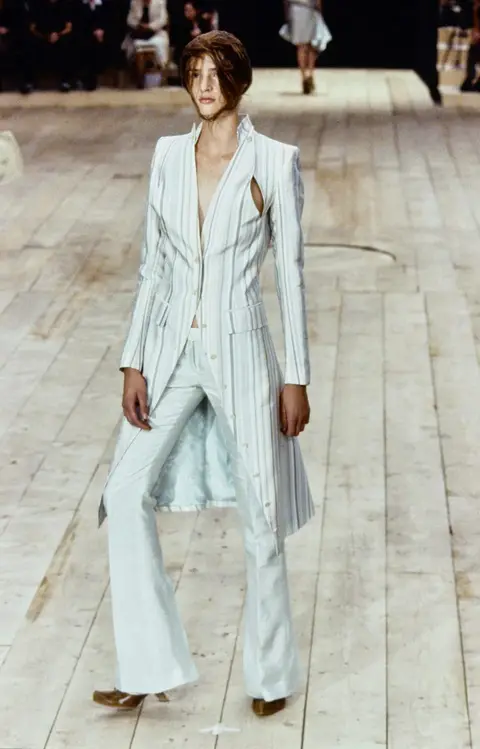
- Pinstripe Long Coat
- The coat features an elongated pinstripe pattern that stretches the verticality of the model. This structural manipulation engages with Deconstructionist Logic by extending the proportions of a standard blazer into a gown-like form. The high side-slits reveal the trousers beneath and allow for a fluid, mobile gait. It asserts a new hybrid between formal menswear and feminine silhouette.
- Flared Trouser Cuff
- The trousers end in a wide, bell-bottom flare that obscures the shoes and creates a solid foundation. Through the lens of Post-Humanism the flare alters the human center of gravity into a wider, more stable geometric shape. The clean white textile emphasizes the purity and precision of the cut. It completes the architectural sweep of the entire striped ensemble.
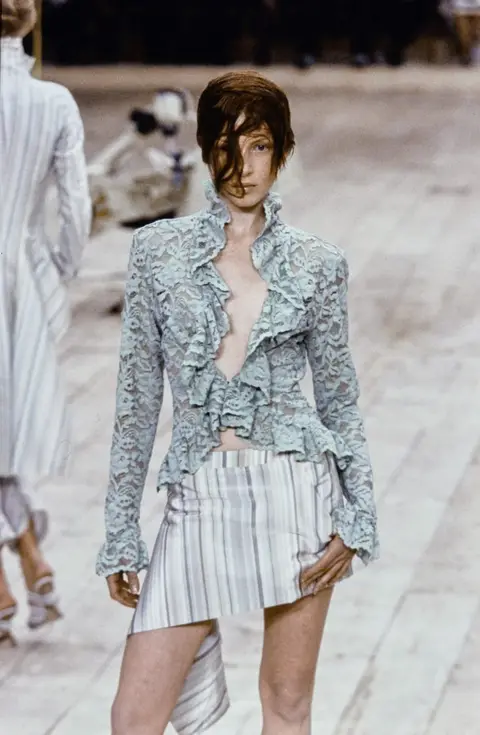
- Ruffled Lace Collar
- The top features intricate blue lace ruffles that cascade down the chest and frame the face. This texture engages with The Grotesque and Abject by mimicry of internal biological membranes or fungal growth. The open center reveals the vulnerability of the skin against the ornate fabric. It refuses the buttoned-up tradition of lace to create an aggressive, romantic exposure.
- Asymmetric Striped Skirt
- The skirt is cut with a sharp diagonal hemline that reveals the legs at varying heights. This irregular geometry engages with Deconstructionist Logic by breaking the symmetry of the human form. The vertical stripes contrast with the chaotic texture of the lace top above. It asserts a sense of structural imbalance and modern instability.
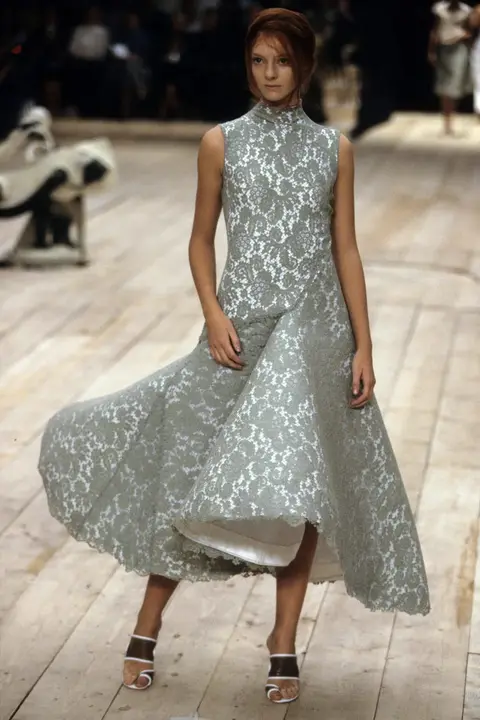
- High Neck Lace
- The dress starts with a tightly fitted lace collar that extends to the chin to elongate the neck. This material choice engages with Body Politics by utilizing a feminine, decorative fabric to enforce a rigid, sculptural posture. The floral patterns are visible against the skin to create a secondary, organic texture. It asserts a sense of aristocratic restraint through delicate textile intervention.
- Circular Lace Hem
- The skirt flares out into a full, circular shape that catches the air and creates a floating volume. Through the lens of The Simulacrum the movement of the lace mimics a natural, biological organism or sea creature. The transparency of the fabric at the edge softens the boundary between the garment and the runway space. It completes the vision of the dress as a kinetic, living sculpture.
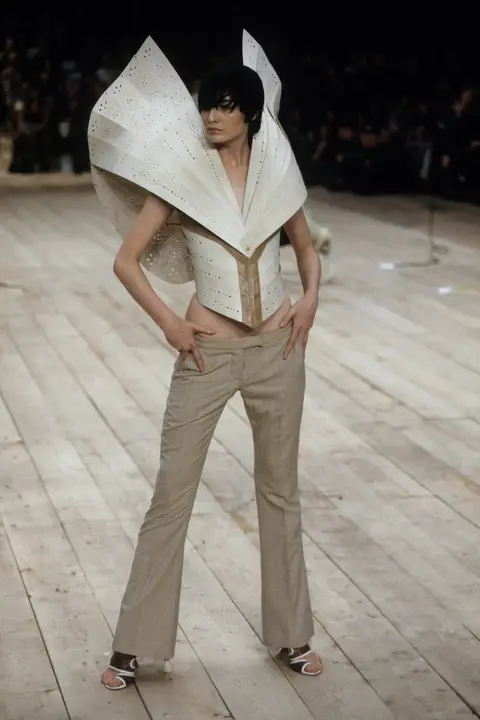
- Pleated Balsa Bodice
- The bodice is constructed from rigid, pleated wooden fans that extend outward from the shoulders. This structural element engages with Deconstructionist Logic by replacing textile with architectural, non-pliable materials. The geometric precision of the pleats creates a dramatic, inhuman silhouette. It refuses the soft drape of traditional fashion to assert a hard-edged, industrial beauty.
- Beige Flared Trousers
- The trousers are tailored in a neutral beige fabric with a clean, pressed crease and a wide flare at the ankle. This grounding garment engages with Body Politics by providing a stable, masculine foundation to the avant-garde bodice. The color palette harmonizes with the natural wood tones of the upper half. It completes the look as a study in organic, architectural hybridity.
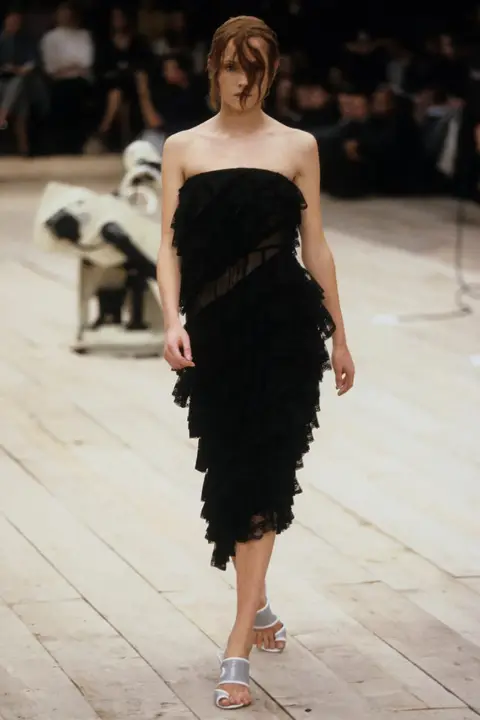
- Strapless Mesh Bodice
- The top of the dress is held by a semi-transparent mesh panel that reveals the structure of the torso. Through the lens of Body Politics the exposure of the skin under lace subverts the modesty of the evening gown. The contrast between the sheer mesh and the opaque ruffles highlights the fragility of the human form. It refuses a total covering to maintain a dialogue between concealment and revelation.
- Tiered Lace Ruffles
- The black dress is composed of multiple horizontal layers of lace that create a dense, tiered texture. This repetition engages with The Grotesque and Abject through its resemblance to dark, organic decay or excessive biological layering. The weight of the lace creates a subtle movement as the model walks. It asserts a somber, gothic romanticism that dominates the runway presence.
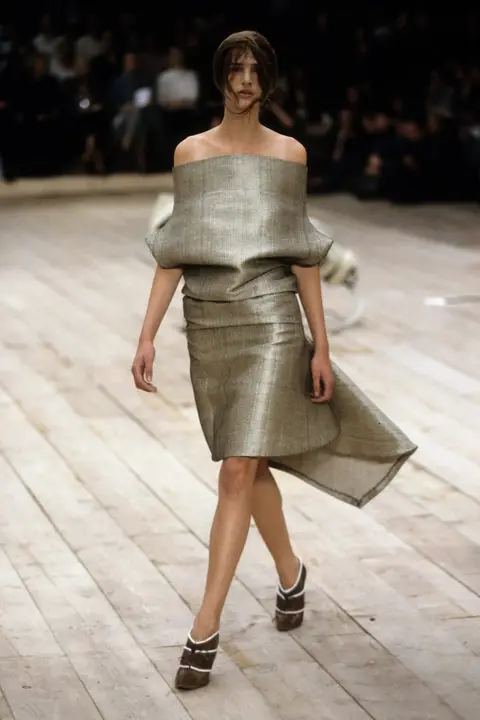
- Woven Metallic Column
- The garment is woven from a stiff, metallic textile that creates a shimmering, rigid tube around the body. This material engages with Cyborg Manifestos by presenting a body encased in a protective, shimmering exoskeleton. The absence of traditional seams emphasizes the monolithic nature of the piece. It asserts the subject as a static, statuesque presence that defies the fluidity of fabric.
- Extended Back Hem
- The fabric extends into a long, trailing panel at the back to create a sense of processional weight. Through Deconstructionist Logic the garment functions as both a sheath and a train to disrupt standard dress categories. The light reflects off the woven texture to create a liquid, shimmering effect during movement. It completes the transformation of the model into a metallicized, non-human entity.
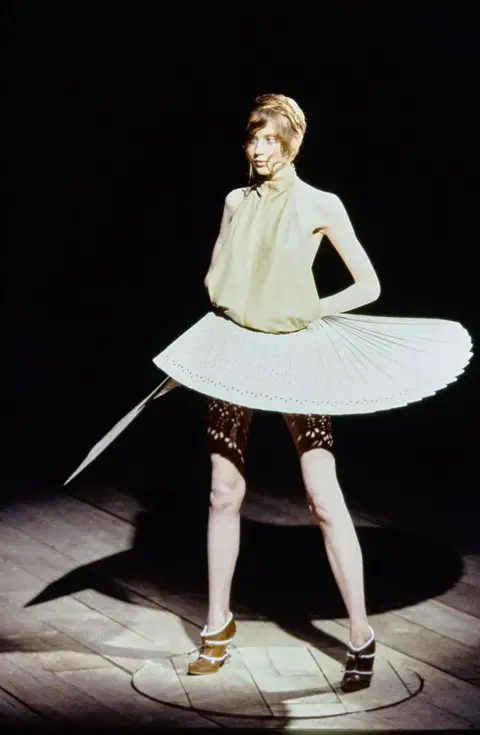
- Halter Leather Top
- The bodice is a simple, tan leather halter that fastens at the neck and leaves the back entirely exposed. Through the lens of Body Politics the leather suggests a raw, animalistic contrast to the mechanical fan skirt. The smooth surface of the hide highlights the organic curves of the model's back. It asserts a primal, biological anchor for the architectural intervention below.
- Laser Cut Fan Skirt
- The skirt is composed of a rigid, laser-cut fan that opens out from the waist in a perfect semi-circle. This element engages with Deconstructionist Logic by utilizing the mechanics of a handheld object to construct a wearable garment. The delicate perforations in the material allow light to pass through and create shadows on the floor. It refuses the traditional wrap of a skirt to assert a purely geometric, rotating volume.
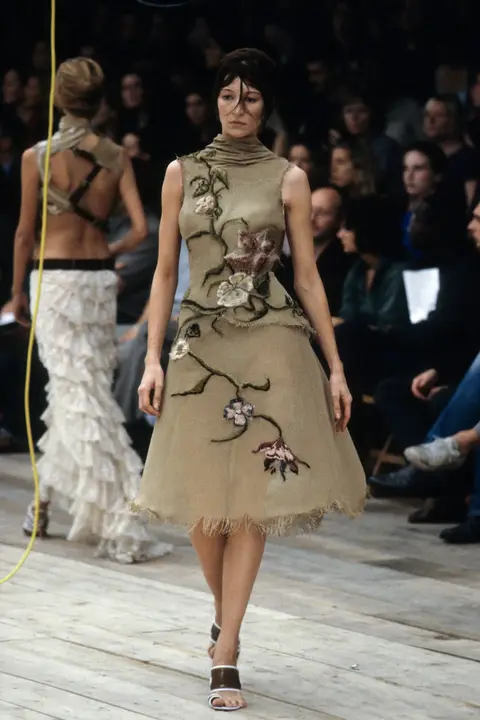
- Embroidered Floral Vine
- A dark, embroidered vine with large floral blossoms is applied across the torso and skirt. Through Post-Humanism the embroidery acts as a biological parasite that appears to be growing directly out of the garment. The three-dimensional quality of the flowers adds a sculptural layer to the flat fabric. It completes the vision of a body reclaiming itself through a fusion with botanical nature.
- Distressed Burlap Hem
- The dress features a raw, frayed hemline that reveals the coarse fibers of the burlap-like textile. This material choice engages with The Grotesque and Abject by elevating a low, industrial fabric to the level of high fashion. The visible threads create a halo of decay around the model's knees. It refuses the finished edge to emphasize the material's humble, organic origins.
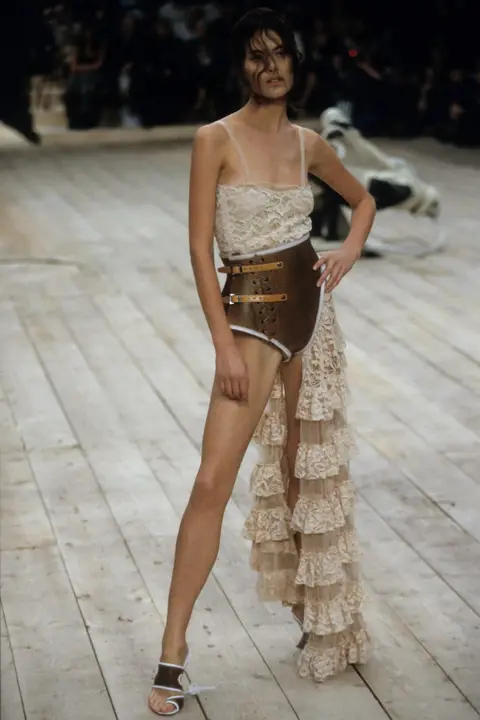
- Brown Leather Girdle
- A wide brown leather girdle with multiple buckles cinches the waist and hips with aggressive force. This element engages with Body Politics by referencing orthopedic corsetry and medical correction as high-fashion fetish. The rigid leather contrasts sharply with the delicate lace undergarment. It asserts a mood of prosthetic constraint that defines the central silhouette.
- Ruffled Lace Train
- A long train of tiered lace ruffles extends from the back of the leather girdle to trail on the floor. Through the lens of Deconstructionist Logic the train is detached from a full dress to become a secondary, decorative appendage. The frothiness of the lace creates a romantic shadow against the hard leather above. It refuses a singular garment identity to present a hybrid of armor and lingerie.
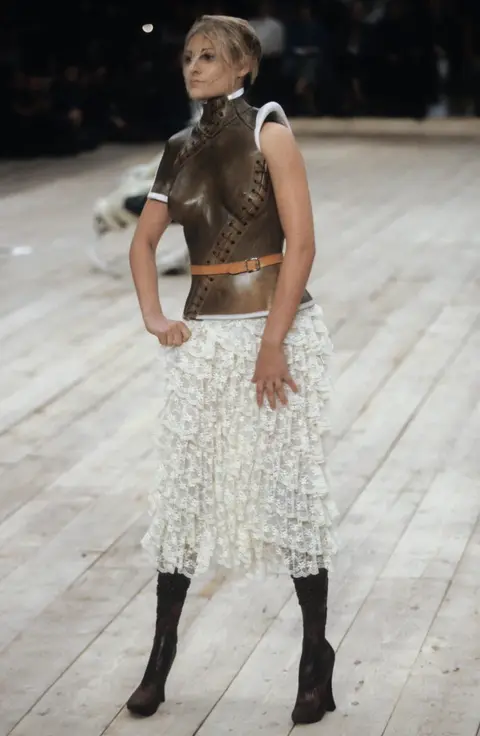
- Molded Leather Cuirass
- The bodice is a rigid, brown leather shell that is anatomically molded to follow the contours of the chest. This piece engages with Cyborg Manifestos by replacing the soft skin with a protective, inanimate hide. The lacing details along the sides suggest a process of enclosure and permanent fixation. It completes the collection's obsession with the hard shell versus the soft interiority of the body.
- Textured Lace-Up Ankle Boots
- A pair of dark, embossed leather ankle boots closes with fine lacing that climbs toward the calf. This detail engages with Body Politics by echoing the diagonal lacing of the cuirass above. The boots ground the ensemble in a utilitarian, almost orthopaedic register rather than a conventional evening shoe. The matte texture absorbs light in contrast to the frothy ivory lace tiers falling around them. It refuses a delicate finish to complete the look's tension between armour and softness.
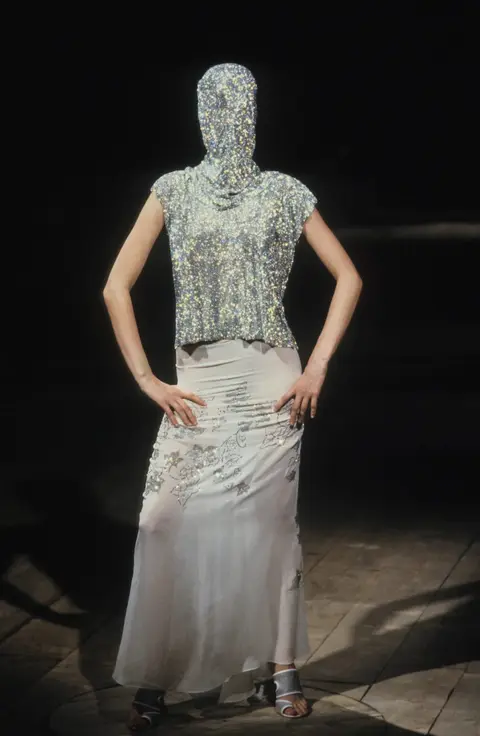
- Shimmering Mesh Face Mask
- A hood of glittering mesh completely obscures the model's face to erase individual identity. This erasure engages with The Grotesque and Abject by transforming the human head into a faceless, monolithic object. The sparkle of the mesh creates a digital, static effect that disrupts the viewer's gaze. It refuses the traditional fashion portrait in favor of a totalizing, decorative objectification.
- Embellished White Skirt
- The long white skirt is decorated with intricate silver floral motifs that echo the texture of the mask above. Through Deconstructionist Logic the embellishment is dispersed across the fabric like a digital glitch or organic sprawl. The weightless quality of the fabric provides a soft contrast to the rigid mask. It completes the look of a spectral, shimmering figure that moves between the material and the digital.
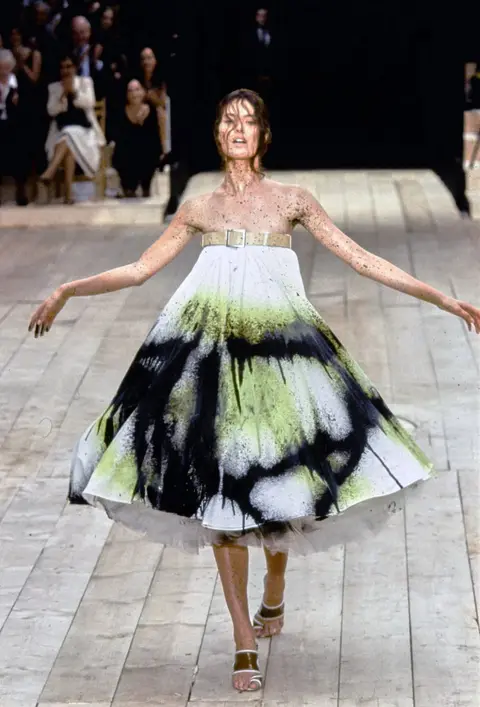
- Belted Empire Waist
- A simple leather belt cinches the white cotton fabric high on the chest to create a voluminous flare below. Through the lens of Body Politics the belt acts as a point of structural restraint that directs the flow of the garment. The purity of the white fabric serves as a necessary contrast to the chaotic paint spray. It completes the silhouette as a victim of a high-tech, performative assault.
- Robotic Pigment Spray
- The dress surface is marked by erratic splashes of acidic yellow and black paint delivered by industrial machines. This visible trauma engages with Cyborg Manifestos to record a violent encounter between technology and craft. The drips and splatters represent the loss of human control in the creative process. It asserts the body as a passive canvas for mechanical intervention.
Photographs: Condé Nast Archive, via Vogue Runway. Reproduced for criticism and review under CDPA 1988 s.30.
Quick facts
- Era
- 1990 to 1999; The Deconstructionist Decade
- Politics
- Body Politics & Corporeal Interventions
- Theories
- Post-Humanism
- Form & anatomy
- Prosthetic Extension
- Materials
- Biological Ephemera
- Geography
- London (BFC)
- Gender
- Womenswear
- Format & medium
- Theatrical Stage Performance