THE LEXICON / Borders and belonging
Hussein Chalayan AW 2000After Words
In a living-room set, models took the covers off chairs and wore them as dresses, and a wooden table turned into a skirt. It was about refugees who must carry their home with them when they flee.
Provenance
Hussein Chalayan presents Afterwords at Sadler's Wells Theatre London in February 2000, staging the collection as a theatrical performance within a schematic mid-century living room complete with grey upholstered chairs, a mahogany coffee table, vases, and a television broadcasting a Bulgarian choir; the presentation is deeply personal, rooted in the designer's Turkish-Cypriot family history of forced displacement during the 1974 partition of Cyprus, and operates as a broader commentary on the ethnic expulsions of the Bosnian War transmitted into European domestic spaces throughout the 1990s. "After Words" is the single most celebrated fashion show of the early 21st century — a work that expanded the definition of what a fashion presentation could be, what a garment could contain, and what clothing could mean. Vogue has called it the best show ever. It won Chalayan his second consecutive British Designer of the Year award (1999 and 2000). Twenty-five years later, it remains the touchstone for any discussion of fashion as performance, fashion as social commentary, and fashion as design across disciplines. The collection was inspired by the experience of war refugees forced to flee their homes — a subject rooted in Chalayan's own biography. Born in Nicosia, Cyprus, in 1970 to Turkish Cypriot parents, Chalayan grew up amid the ethnic conflicts and territorial division that followed the Turkish invasion of 1974. His family relocated to England in 1978. As a child, he had asked his mother what she would take with her if they had to leave: "Some photographs, a blanket and favourite clothes." That question — what do you carry when you lose everything? — became the conceptual engine of the collection. The immediate contextual trigger was the Kosovo War of 1998–1999 and the displacement of Bosnian refugees, but the resonance was universal and autobiographical. The show was staged at Sadler's Wells Theatre in North London — a venue associated with dance and performance, not fashion — and was produced by Alexandre de Betak, who had been collaborating with Chalayan since 1997. The stage was transformed into a minimal, white living room: a bare space flanked by asymmetrical planes on three sides, furnished with 1950s-style geometric chairs, a circular mahogany coffee table, a flat-screen television, and an object-filled shelf. A live Bulgarian choir sang throughout, their voices filling the space with an atmosphere that was simultaneously mournful and hypnotic. Chalayan recalled the rehearsal the night before at his Covent Garden studio as one of his most cherished memories: the choir's voices filling the courtyard while the team prepared the clothes. The show opened not with a model but with a family — a mother, father, grandmother, and children — who entered and sat in the living room in silence. They were not models but ordinary people, cast to convey that displacement could happen to any family. After the family departed, the runway looks emerged. These were deceptively restrained: jackets and dresses traced with contrast piping that explored the relationship between line and depth, with the piping creating an almost optical illusion of movement against the garment's surface. Many pieces were engineered with intricate folds and pleats — origami-like structures that revealed Chalayan's obsession with volume and transformation. A blue dress in concentrated tulle demonstrated immaculate construction. The mood was quiet, modest, and precise in the manner characteristic of Chalayan's best work: meaningful and controlled, with the chicness embedded in the intelligence of the cut rather than in surface decoration. Clear plastic patches appeared on the models' faces. Three black cocktail dresses toward the end of the conventional runway sequence served as an omen of what was to come. The finale was, and remains, one of the most extraordinary sequences in fashion history. Models entered the living room set and began to interact with the furniture. They seized the objects from the shelf and thrust them into specially designed pockets in their coats and garments — letters, photographs, small domestic objects — enacting the refugee's desperate gathering of possessions. Four women in grey shift dresses then approached the chairs, removed the fabric slipcovers, and put them on as dresses. The chairs — their wooden frames now exposed — folded up and became suitcases, which the women carried off the stage. Finally, a single model stepped into the centre of the circular mahogany coffee table, pulled it up to her waist, and hitched it to a belt. The table's concentric wooden slats rose and telescoped into a geometrical, perfectly balanced skirt. She walked off the stage wearing the furniture, leaving the room completely empty. "I feared things going wrong, but the risk was so worth taking," Chalayan said immediately after the show. The engineering of the transformable furniture-garments was painstaking: each piece was honed through extensive trial and error to ensure it could be worn, walked in, and converted live on the runway. The slipcover-dresses had to be removable from the chairs and wearable as functional garments. The chair frames had to fold into convincing suitcases. The coffee table had to rise into a balanced, wearable skirt. These were not theatrical props; they were feats of design engineering that bridged furniture, fashion, and industrial design. The coffee table skirt was subsequently exhibited at Tate Modern's Century City exhibition in 2001 and is held by the Mudam Luxembourg collection (acquired 2000). The Geotrophics collection of SS 1999 had already explored the concept of chair dresses and nomadic existence, but "After Words" expanded the idea to its fullest and most emotionally devastating expression. The collection is significant as the definitive statement of Chalayan's career-long investigation into displacement, identity, and the relationship between the body and its built environment. It is essential to any archive concerned with fashion as performance, fashion as social commentary, the politics of migration and belonging, and the cross-pollination of fashion with architecture, furniture design, and the performing arts. Its ongoing ability to provoke conversation about immigration and human survival — qualities that have only intensified in relevance — confirms its status as one of the most important fashion presentations of any era.
Critique
Afterwords positions clothing as a portable territory and psychological shelter, exploring how displaced individuals carry domestic memory and material history on their bodies when forced to evacuate; the collection constitutes a Post-Colonial Critique of static property ownership and the violent erasure of the private sphere during ethnic conflict; by requiring models to physically dismantle the set and wear it Chalayan enforces a bodily autonomy and transgression that collapses the boundary between architectural environment and biological body; the collection proves fashion capable of functioning as an intellectual tool for complex sociological inquiry, treating the human form as a structure around which clothing may cocoon to preserve identity when private space is violently lost.
Strategy
The structural logic centres on Adaptive Transformation, engineering garments that transition seamlessly between domestic furniture and wearable clothing; models remove grey seat covers from chairs, invert them to reveal contrasting colours, and slip them on as dresses; men in hazmat suits fold the remaining wooden chair frames into portable suitcases, and in the show's dramatic finale a model steps inside the hollow coffee table, lifts it by inner handles attached to a waist harness, and the table telescopes outward into a geometric tiered wooden skirt; each transformation enforces a narrative in which household objects are mobilised as vehicles of physical survival.
Looks

- Tiered Solid Wood Skirt
- The tiered solid wood construction locks the lower body within a series of concentric rings. It physically anchors the wearer to the floor. This rigid geometric abstraction engages with theories of corporeal confinement and spatial occupation. The heavy mahogany-toned timber visibly restricts natural stride to enforce a stilted ceremonial gait. The architecture refuses soft textile traditions to assert a permanent domestic barrier around the human subject.
- Asymmetrical Folded Bodice
- The asymmetrical folded bodice utilizes a crisp blue fabric wrapping tightly across the torso. It leaves the lower midriff exposed. This application engages with post-structuralist ideas of fracture and instability. The jagged raw edges and diagonal seaming contrast severely with the perfect circles of the wooden base. This upper garment completes the silhouette by introducing an element of rushed improvisation against the solid furniture beneath.
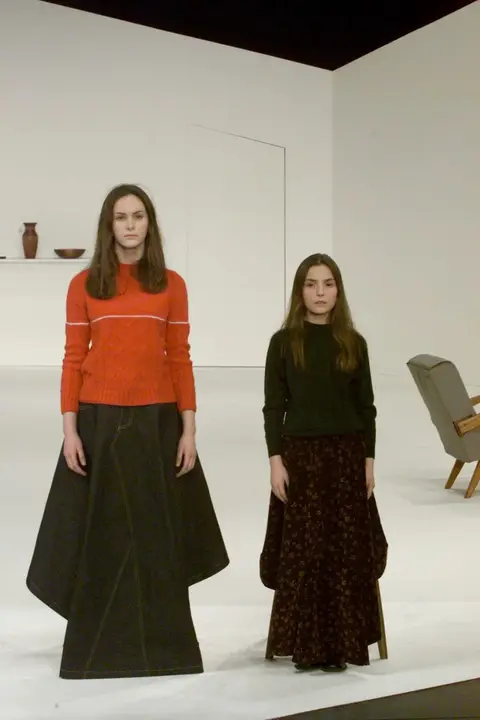
- High-Waisted Flared Denim Skirt
- The high-waisted flared denim skirt utilizes contrasting yellow topstitching to map a complex geometric web across the lower body. This visible construction technique invokes theories of structural transparency and domestic labor. The stiff fabric holds an A-line shape independently of the legs beneath. It creates a rigid hollow volume. The garment asserts a sturdy utilitarian foundation intended for rigorous physical endurance.
- Heavy Gauge Red Knitwear
- The heavy gauge red knitwear features dense interlocking cables crossed by a singular white horizontal stripe. This traditional textile engages with diasporic narratives concerning the preservation of heritage through domestic craft. The thick yarn creates a bulky insulated barrier over the torso. It swallows the natural shoulder line entirely. The piece refuses sleek modernism to assert a deeply rooted maternal warmth.
- Dropped-Pocket Gathered Skirt
- The dropped-pocket gathered skirt utilizes a dark floral velvet to create heavy draped volumes at the sides of the legs. This material accumulation engages with feminist critiques of hidden labor and the hoarding of resources during crisis. The dense fabric obscures the exact anatomy of the lower limbs. It forces the fabric to pool heavily toward the floor. The garment completes the paired composition by mirroring the rigid geometry of the adult with soft collapsed folds.
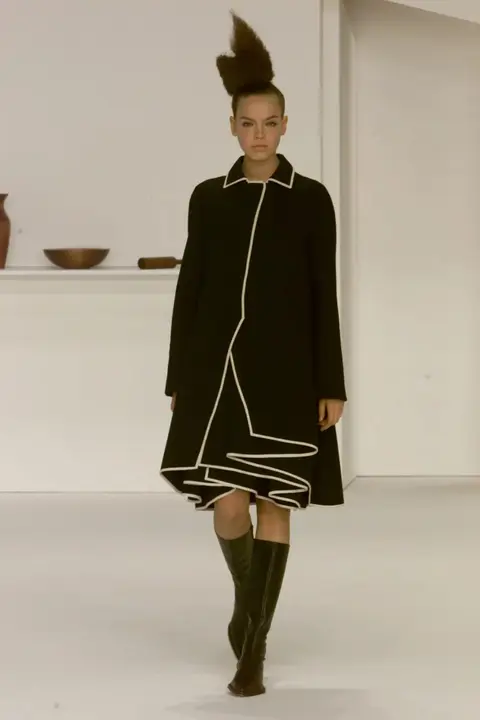
- Piped Asymmetrical Hemline
- The piped asymmetrical hemline folds back upon itself to reveal cascading triangular layers. This deliberate exposure of the internal structure invokes deconstructionist logic regarding the inner and outer self. The stark white binding traces the chaotic edges of the dark wool to highlight every engineered crease. It functions like an architectural blueprint drawn directly onto the body. The construction refuses linear symmetry to assert an aesthetic of controlled unraveling.
- Sculpted Hair Form
- The sculpted hair form projects upward into a rigid organic mass defying gravity. This styling choice engages with theories of the abject by transforming natural biological output into a strange architectural appendage. The matte texture of the hair mimics spun wool or dense felt. It completely ignores normal hair styling protocols. This element completes the silhouette by extending the vertical axis of the body into unfamiliar airspace.
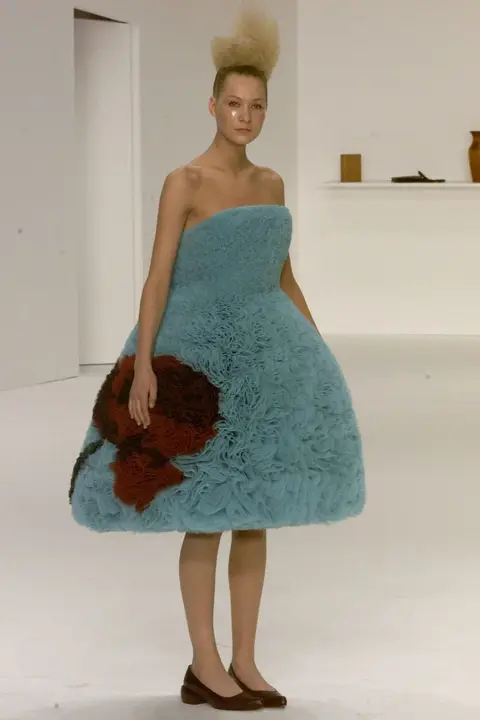
- Tufted Volumetric Silhouette
- The tufted volumetric silhouette envelopes the torso in a dense mass of gathered blue tulle. This extreme textual buildup engages with theories of the simulacrum by mimicking the appearance of domestic bath sponges or synthetic insulation. The material expands outward to completely erase the waistline. It obscures the skeletal structure entirely. The garment refuses traditional bodily contours to assert a protective cloud-like buffer.
- Oversized Floral Applique
- The oversized floral applique disrupts the pale blue field with a heavy textured intrusion of dark red and brown. This graphical intervention invokes post-colonial ideas of scarred landscapes and corrupted natural beauty. The dark fibers appear matted and deeply entrenched within the lighter tulle. They form a dense visual sinkhole. The detail completes the dress by anchoring the ethereal volume with a dense grounded focal point.
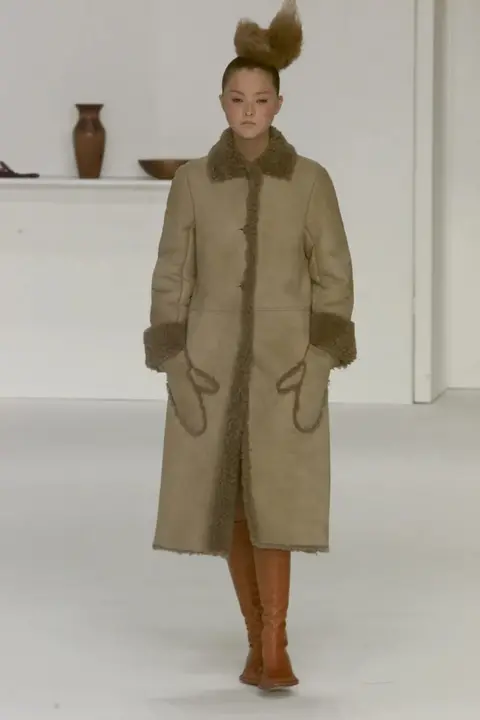
- Integrated Shearling Mittens
- The integrated shearling mittens emerge seamlessly from the coat sleeves to permanently encase the hands. This anatomical erasure engages with biopolitical frameworks regarding the loss of individual agency and manual dexterity. The thick suede and exposed fleece lining offer extreme insulation. They fuse the limb into a single blunt instrument. The garment asserts total bodily enclosure as a necessary defense mechanism against hostile external forces.
- Raw Fleece Binding
- The raw fleece binding traces the central closure and lapels with exposed animal texture. This material honesty invokes eco-critical theories regarding the primal relationship between human survival and animal byproducts. The fuzzy trim breaks up the smooth beige expanse of the suede. It highlights the seams of the exterior shell. The detail refuses polished refinement to assert a rugged utilitarian logic.
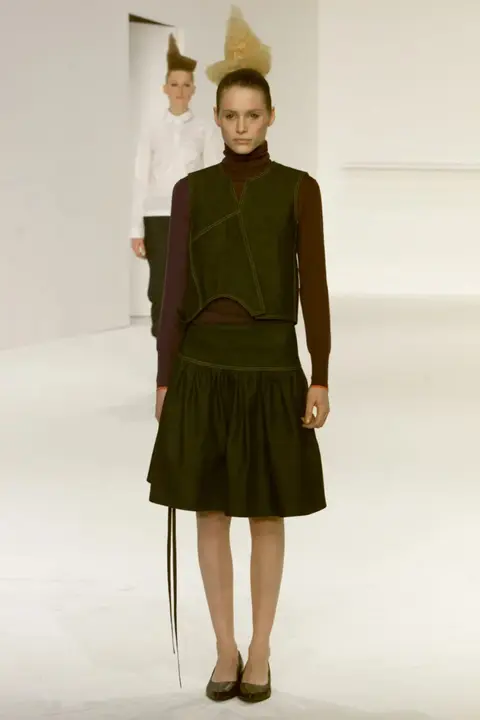
- Cropped Geometric Vest
- The cropped geometric vest features stark angular cutouts at the hemline exposing the knitwear beneath. This fragmented layering engages with theories of fractured identity and modular assembly. The heavy contrast stitching outlines the internal seams to map the construction directly on its surface. It creates a web of bright lines across the dark fabric. The piece refuses whole coverage to assert a fragmented protective shell.
- Elongated Skirt Tether
- The elongated skirt tether hangs from the hem down to the floor like a disconnected leash. This trailing element invokes narratives of displacement by suggesting an untied anchor or a dragging lifeline. The thin dark cord disrupts the otherwise clean horizontal break of the skirt. It drags heavily across the runway. The detail completes the silhouette with an unsettling sense of unfinished business or hasty departure.
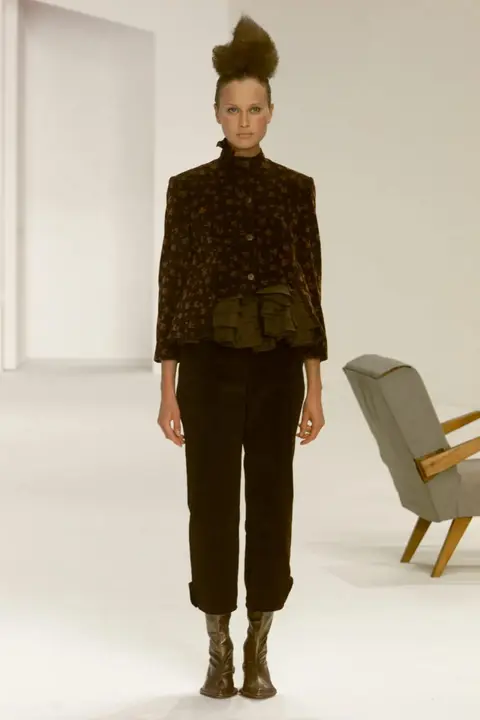
- Tiered Ruffle Peplum
- The tiered ruffle peplum erupts from beneath the tailored floral jacket in dense gathered folds. This material overflow engages with feminist theories of excess and the bursting of domestic containment. The drab olive fabric cascades irregularly over the waistband of the trousers. It obscures the mechanical fastenings of the pants. The design refuses streamlined tailoring to assert a chaotic rupture at the center of the body.
- Woven Floral Outerwear
- The woven floral outerwear utilizes a dark botanical pattern reminiscent of vintage upholstery. This textile choice invokes theories of memory and the haunting presence of the domestic interior. The stiff fabric holds a rigid boxy shape around the shoulders. It mimics the immovable bulk of an armchair. The garment asserts a camouflage effect designed to blend the wearer into a forgotten living room.
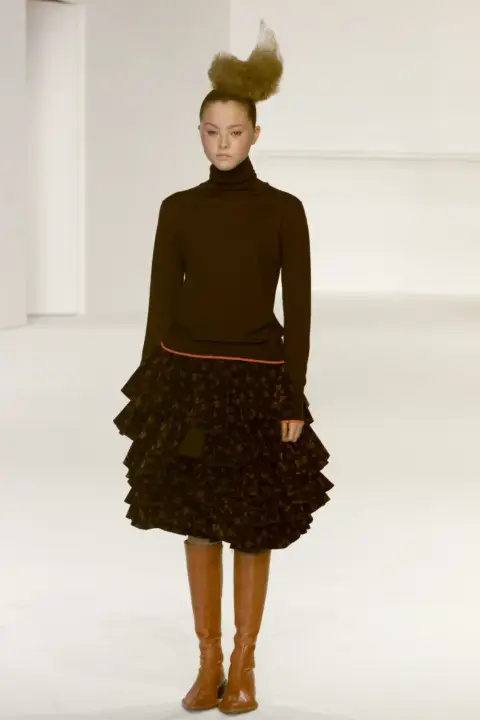
- Tiered Floral Ruffle Skirt
- The tiered floral ruffle skirt builds immense volume through stacked horizontal layers of dark patterned fabric. This structural accumulation engages with theories of hoarding and the physical weight of accumulated history. The dense gathers swing heavily away from the legs. They create a wide bell shape entirely through material excess. The garment refuses sleek modernity to assert a burdensome connection to the past.
- Smooth Monochromatic Turtleneck
- The smooth monochromatic turtleneck creates a stark untextured column across the upper body. This minimalist intervention invokes concepts of erasure and the silencing of the individual voice. The dark knit fits tightly against the skin to contrast wildly with the explosive skirt below. It functions as a void against the heavy floral print. The piece completes the ensemble by providing a severe anchor to the chaotic lower half.
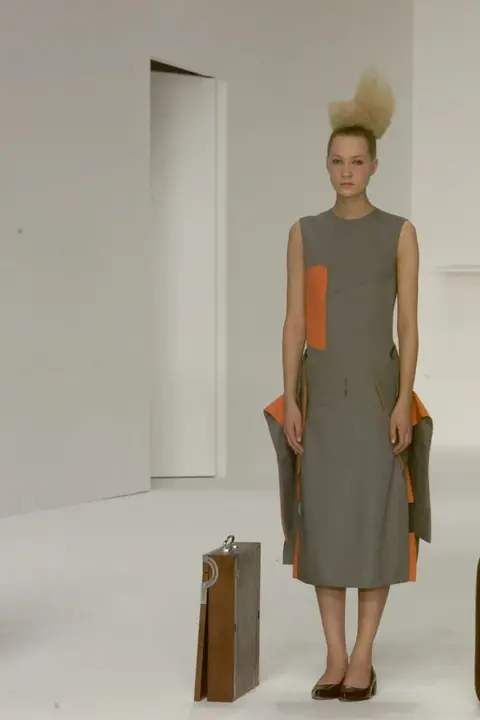
- Hinged Timber Suitcase
- The hinged timber suitcase rests heavily beside the legs as a stark geometric block. This carried object engages directly with diasporic theory by materializing the burden of forced relocation. The visible metal brackets and wooden panels reveal its origin as a piece of domestic furniture. It serves as a literal fragment of the abandoned home. This accessory refuses the logic of traditional leather goods to assert survival through radical readaptation.
- Contrast Geometric Paneling
- The contrast geometric paneling inserts bright orange shapes into the drab grey field of the dress. This sharp color blocking invokes theories of emergency signage and high-visibility crisis gear. The curved and angular cutouts disrupt the flat surface of the shift dress. They hover asymmetrically over the hips and waist. The garment asserts a state of alert within an otherwise muted aesthetic.
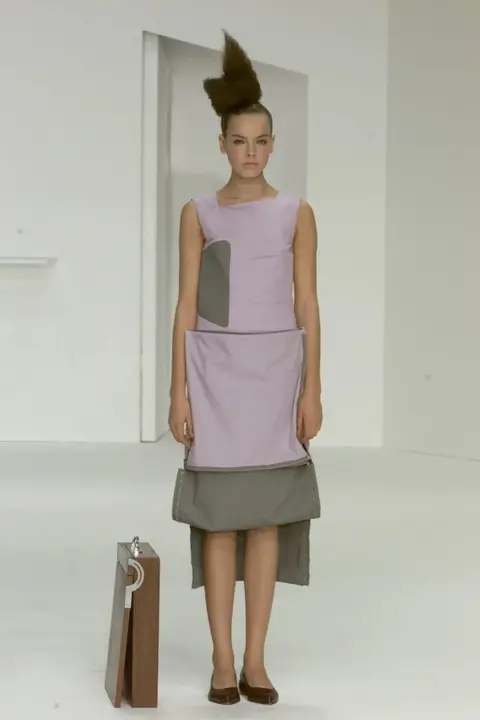
- Exposed Zipper Track Hem
- The exposed zipper track hem lines the bottom edge of the stiff overskirt with heavy metallic teeth. This functional hardware engages with concepts of modularity and the rapid dismantling of boundaries. The track remains open and unfastened to suggest a recently detached component. It hints at a missing lower tier. The detail refuses permanent finishing to assert the garment as an ongoing process of assembly.
- Asymmetrical Bodice Cutout
- The asymmetrical bodice cutout inserts a stark grey rectangular panel into the pale lilac fabric. This severe geometric interruption invokes minimalist architectural theory. The contrasting block sits flat against the right ribs without following the natural curvature of the body. It mimics a boarded-up window. The top completes the look by echoing the rigid geometry of the wooden suitcase carried below.
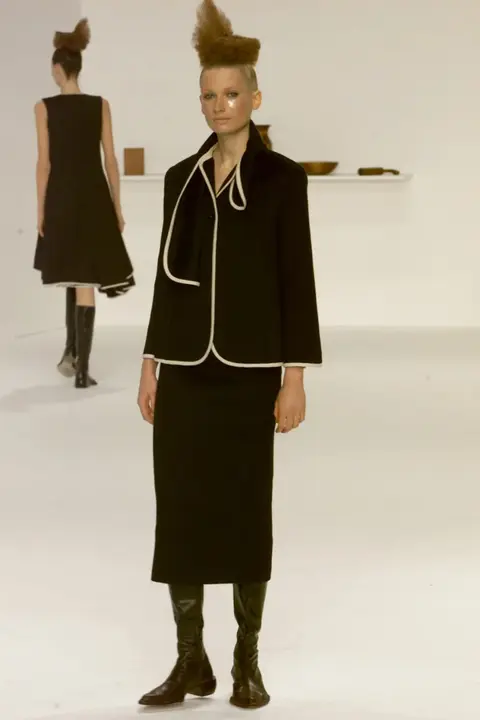
- Oversized Piped Ascot
- The oversized piped ascot hangs loosely from the neckline with thick white binding. This exaggerated detailing engages with theories of the absurd by inflating a traditional symbol of bourgeois formality. The floppy black loops droop heavily over the chest. They obscure the structured lapels entirely. The element refuses rigid tailoring to assert a deflated melancholic presence.
- High-Gloss Pointed Boot
- The high-gloss pointed boot reflects light sharply off its elongated toe box. This aggressive footwear choice invokes concepts of militarization and rapid forward momentum. The stiff leather encases the calf tightly beneath the hem of the skirt. It provides a hard protective shell. The accessory completes the dark uniform by grounding it in severe polished armor.
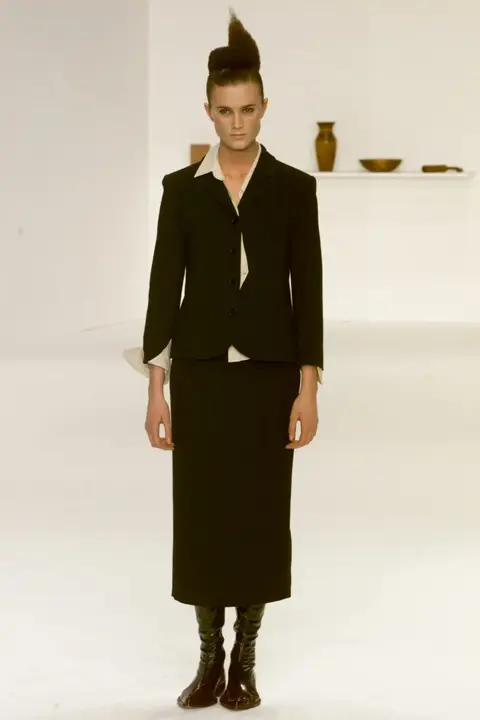
- Unfastened Tailored Cuff
- The unfastened tailored cuff folds back to reveal a stark white shirt sleeve extending past the wrist. This deliberate styling choice engages with theories of unraveling formality and the disruption of corporate armor. The dark jacket sleeve hangs open rather than buttoning tight. It exposes the soft underlayer completely. The detail refuses polished completion to assert a state of hasty dressing or sudden departure.
- Austere Columnar Skirt
- The austere columnar skirt drops straight to the mid-calf without pleats or gathering. This extreme reduction of volume invokes minimalist theory and the erasure of traditional feminine excess. The dense black fabric absorbs light to create a flat two-dimensional silhouette. It strictly follows the vertical drop of the hips. The garment asserts a disciplined and highly restricted physical mobility.
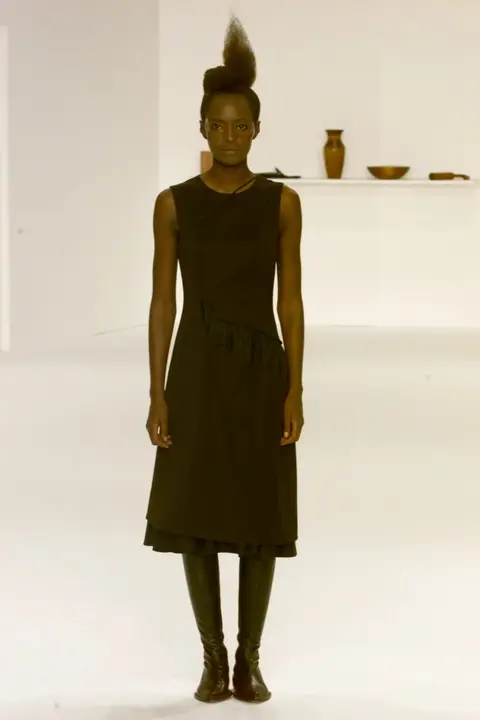
- Fringed Diagonal Slash
- The fringed diagonal slash violently interrupts the smooth front of the dress with a burst of textured fabric. This physical rupture engages with trauma theory by manifesting a visible wound across the torso. The dark shredded material spills out from the clean edges of the opening. It completely breaks the minimal plane of the shift dress. The garment refuses pristine wholeness to assert a permanently scarred exterior.
- Sculpted Hair Form
- The sculpted hair form twists upward into an asymmetrical tower of matted fibers. This bodily manipulation invokes theories of the uncanny by rendering natural hair as a stiff synthetic-looking structure. The shape leans precarious to one side defying natural growth patterns. It resembles a damaged chimney or broken branch. The styling completes the severe aesthetic by extending the vertical tension of the dark silhouette.
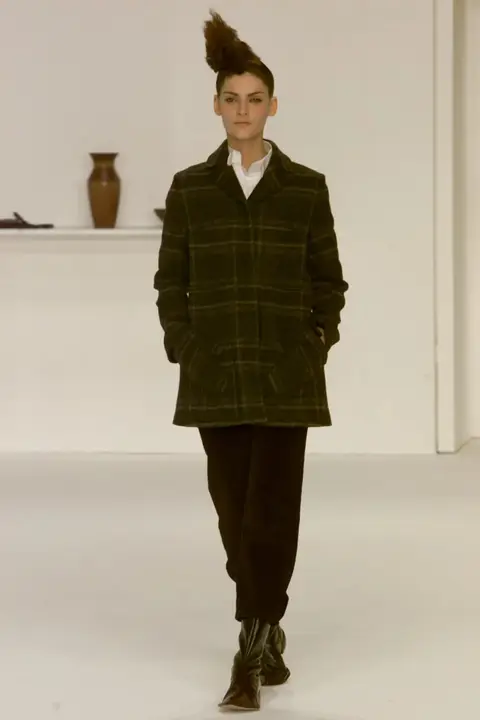
- Muted Tartan Outerwear
- The muted tartan outerwear utilizes a dim green and brown grid to construct a boxy utilitarian jacket. This specific textile engages with class theory by referencing working-class uniforms and rural isolation. The stiff fabric holds its shape rigidly away from the torso. It creates a square protective volume. The garment asserts a practical defensive layer devoid of decorative luxury.
- Concealed Hand Posture
- The concealed hand posture involves deep oversized pockets that completely swallow the model's extremities. This physical obscuring engages with theories of hidden intent and the protection of vulnerable appendages during flight. The structure of the jacket is pulled taut across the hips by the internal pressure of the arms. It generates horizontal tension across the plaid. The detail completes the defensive stance of the overall look.
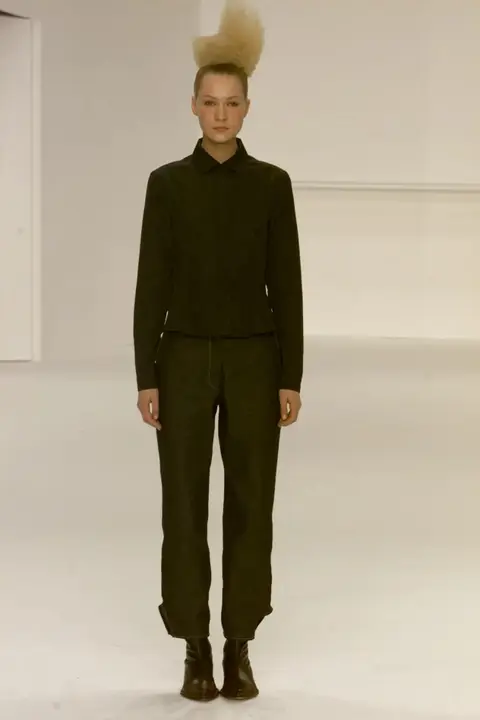
- Gathered Peplum Hem
- The gathered peplum hem introduces a sudden burst of volume at the waistline of the severe dark jacket. This structural addition engages with feminist critiques of enforced silhouettes by sharply defining the hips against an otherwise masculine cut. The tight pleating restricts the drape of the fabric. It forces the hem to flare violently outward. The garment refuses a straight drop to assert a strictly controlled architectural waist.
- Folded Trouser Cuff
- The folded trouser cuff snaps up abruptly to reveal an uneven ankle line and stark white interior binding. This finishing technique invokes aesthetics of utility and the immediate need for mobility. The dark stiff denim holds the fold securely without traditional hemming. It exposes the heavy boots fully. The detail completes the ensemble by signaling readiness for hostile terrain.
Photographs: JB Villareal / Shoot Digital, via Vogue Runway. Reproduced for criticism and review under CDPA 1988 s.30.
Quick facts
- Era
- 2000 to 2009; The Global Conglomerate Era
- Politics
- Post-Colonialism & Diasporic Narratives
- Theories
- Post-Colonial Critique
- Form & anatomy
- Modular Componentry
- Materials
- Domestic Found Objects
- Geography
- London (BFC)
- Gender
- Womenswear
- Format & medium
- Theatrical Stage Performance